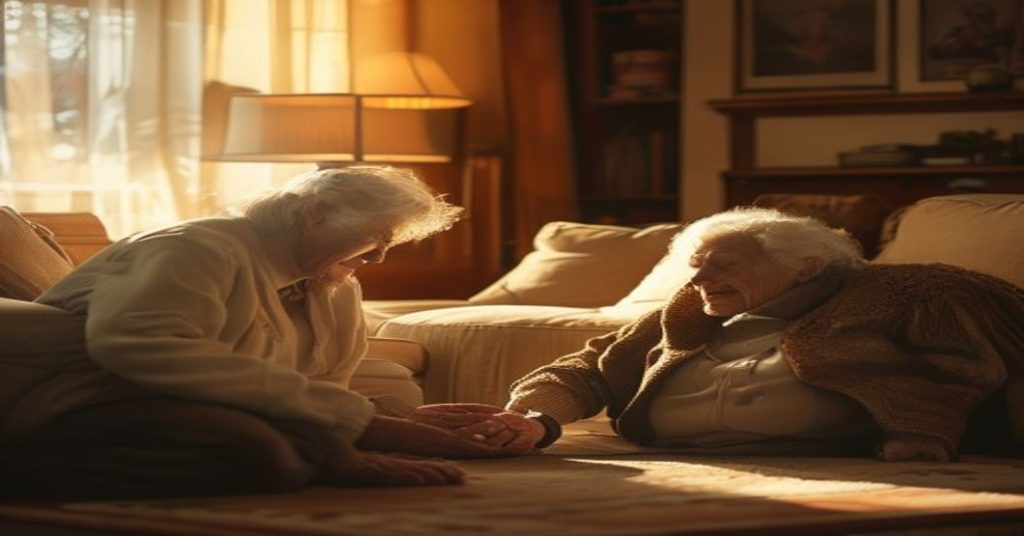
When 82-year-old Harold Simmons slipped on a rug in his living room, his first instinct was to try to get up immediately. “I grabbed the edge of the sofa and tried to pull myself up,” he recalls. “But my hip hurt too much, and I realized I needed help.” Harold’s situation is common — according to the CDC, falls result in over 3 million emergency department visits among older adults each year [1]. Knowing what to do in those critical first moments can make a significant difference in outcomes.
This guide provides clear, step-by-step instructions for what to do immediately after a senior falls at home, based on recommendations from the CDC, the National Institute on Aging, and the American Academy of Orthopaedic Surgeons.
Stay Calm and Assess the Situation
The first and most important step is to stay calm. Take a few deep breaths and assess your situation before moving. Ask yourself: Are you in pain? Can you move your arms and legs? Do you see any blood or feel any obvious injuries? Do you feel dizzy or confused? Head injuries and hip fractures are the most serious potential consequences of a fall in seniors, and moving incorrectly can worsen an injury [2].
If You Cannot Get Up
If you are injured, in pain, or unable to get up safely, call for help immediately. The NIA recommends the following steps [3]:
- Call 911 if you have a phone within reach or wear a medical alert device
- If you cannot reach a phone, try to make noise by calling out loudly or tapping on a hard surface with an object
- If you have a mobile phone, keep it in a pocket or attached to your clothing at all times
- Stay warm by covering yourself with nearby clothing, towels, or a blanket
- Try to move to a more comfortable position by sliding or rolling slowly, but only if you can do so without pain
“The most dangerous thing you can do after a fall is try to get up too quickly. Take 30 seconds to breathe, assess how you feel, and then decide your next move. Panicking leads to more injuries.” — Dr. Karen Liu, Orthopedic Specialist
How to Get Up Safely After a Fall
If you are not injured and feel able to get up, the CDC’s STEADI program recommends the following safe method [4]:
- Roll onto your side and rest briefly
- Slowly push your upper body up using your arms
- Get on your hands and knees and crawl to a sturdy piece of furniture, such as a chair or sofa
- Place both hands on the furniture and lift one knee so your foot is flat on the floor
- Using your leg and arm strength, slowly push yourself up to a standing position
- Sit down carefully and rest before moving further
For Caregivers: What to Do When a Loved One Falls
If you are caring for a senior and witness a fall, or find them on the floor, the NIA recommends the following [3]:
- Stay calm and speak reassuringly
- Do not move them immediately — ask where they hurt
- Check for bleeding, bruising, or swelling
- If they hit their head, assume a head injury and call 911
- If they cannot move a limb or bear weight, call 911
- Keep them warm and comfortable while waiting for help
- After the incident, document what happened and share with their doctor
After the Fall: Medical Follow-Up
Even if a fall seems minor, it is important to seek medical evaluation. The CDC reports that many fall-related injuries are not immediately apparent [4]. A doctor can check for hidden injuries, review medications that may have contributed to the fall, assess balance and mobility, and recommend a fall prevention plan. “Every fall is a warning sign,” says Dr. Rodriguez. “Even if there is no injury, a fall indicates that something needs to change — whether it is medication, footwear, home safety, or physical condition.”
Preventing Future Falls
After a fall, take steps to reduce the risk of another one. Review the home safety checklist provided by the CDC’s STEADI program: remove loose rugs, improve lighting, install grab bars in the bathroom, and review medications with your doctor [4]. Balance exercises and strength training can also significantly reduce fall risk.
You Are Not Alone
Harold Simmons now keeps his phone in a pouch that clips to his belt and has installed grab bars in his bathroom. “Falling was scary, but learning what to do made me feel more in control,” he says. “I know the steps now, and I have a plan.” Falling does not mean losing your independence. With the right knowledge, preparation, and support, seniors can recover from a fall and continue living safely and confidently at home.
References
- CDC — Falls Data and Statistics
- AAOS — Hip Fractures in Older Adults
- NIA — Falls and Fall Prevention
- CDC STEADI — Patient Resources
About: SilverWell Hub editorial team. Reviewed by Dr. Sarah Mitchell, MD.
Sources: Content adapted from CDC and NIA fall prevention resources.
Disclaimer: See Medical Disclaimer.
