

What Are the Common Causes and Risk Factors?
The median nerve typically provides feeling and movement to the thumb side of the hand. This includes feeling in the palm, thumb, index finger, middle finger, and thumb side of the ring finger.
The area in your wrist where the nerve enters the hand is called the carpal tunnel. This tunnel is normally narrow. A thick ligament (tissue) just under your skin (the carpal ligament) makes up the top of this tunnel. Any swelling can pinch the nerve and cause pain, numbness, tingling, or weakness. This is called carpal tunnel syndrome.
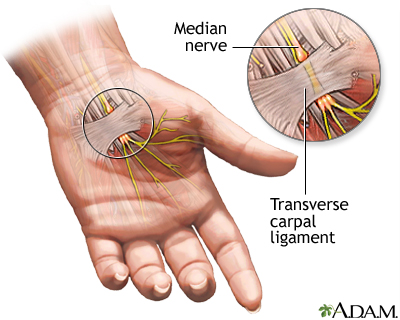
Some people who develop carpal tunnel syndrome were born with a small carpal tunnel.
Carpal tunnel syndrome can also be caused by making the same hand and wrist motion over and over. Using hand tools that vibrate, such as drills or hammers, may also lead to carpal tunnel syndrome.

Studies have not proved that carpal tunnel is caused by typing on a computer, using a mouse, or repeating movements while working, playing a musical instrument, or playing sports. But, these activities may cause tendinitis or bursitis in the hand, which can narrow the carpal tunnel and lead to symptoms.
Carpal tunnel syndrome occurs most often in people ages 30 to 60. It is more common in women than men.
Other factors that may lead to carpal tunnel syndrome include:
- Alcohol use
- Bone fractures and arthritis of the wrist
- Cyst
or tumor that grows in the wrist - Infections
- Obesity
-
Extra fluids retained during pregnancy or
menopause - Rheumatoid arthritis
- Diseases that have abnormal deposits of protein in the body ( amyloidosis )
What Are the Symptoms and Warning Signs?

Symptoms may include any of the following:
- Clumsiness of the hand when gripping objects
- Numbness or tingling
or tingling in the thumb and the next two or three fingers of one or both hands - Numbness or tingling of the palm of the hand
- Pain that extends to the elbow
- Pain in the wrist or hand in one or both hands
- Problems with fine finger movements (coordination) in one or both hands
- Wasting away of the muscle under the thumb (in advanced or long-term cases)
- Weak grip or difficulty carrying bags (a common complaint)
- Weakness
in one or both hands
📖 What Are Exams and Tests?
What Are Exams and Tests?
During a physical exam, your health care provider may find:
- Numbness in the palm, thumb, index finger, middle finger, and thumb side of your ring finger (some people have variations in the location of numbness)
- Weak hand grip
- Tapping over the median nerve at your wrist may cause pain to shoot from your wrist to your hand (this is called the Tinel sign)
- Bending your wrist down all the way for 60 seconds will usually result in numbness, tingling, or weakness (this is called the Phalen test)
- Difficulty in identifying two points along the fingers
Tests that may be ordered include:
- Wrist x-rays
to check for other problems, such as arthritis in your wrist or an abnormal growth - Electromyography
(EMG, a test to check muscles and the nerves that control them) - Nerve conduction velocity
(a test to see how fast electrical signals move through a nerve)
📖 How Is It Treated?
How Is It Treated?
Your provider may suggest that you:
- Wear a wrist splint at night for several weeks. If this does not help, you may need to wear the splint during the day as well.
- Avoid sleeping on your wrists.
- Place warm and cold compresses on the affected area.
Changes you can make in your workplace to reduce the stress on your wrist include:
- Using special devices, such as keyboards, different types of computer mouse, cushioned mouse pads, and keyboard drawers.
- Having someone review the position you are in when performing your work activities. For example, make sure the keyboard is low enough so that your wrists are not bent upward while typing. Your provider may suggest an occupational therapist to help with this assessment.
- Making changes in your work duties or home and sports activities. Some of the jobs linked with carpal tunnel syndrome include those that involve vibrating tools.
MEDICINES
Medicines used to treat carpal tunnel syndrome include nonsteroidal anti-inflammatory drugs (NSAIDs), such as ibuprofen or naproxen. Corticosteroid injections can be given into the carpal tunnel area to relieve symptoms. These treatments usually give only temporary relief.
SURGERY
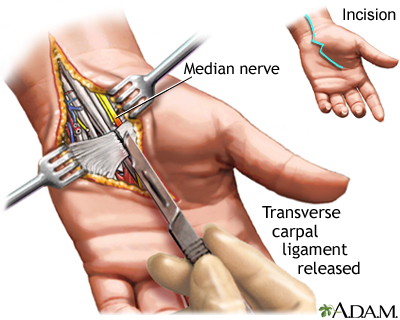
Carpal tunnel release is a surgical procedure that cuts into the ligament that is pressing on the nerve. Surgery is successful most of the time, but depends on how long you’ve had the nerve compression and its severity.
📖 What Is Outlook (Prognosis)?
What Is Outlook (Prognosis)?
Symptoms often improve without surgery. But more than one half of cases eventually need surgery. Even if surgery is successful, full healing can take months.
📖 What Are Possible Complications?
What Are Possible Complications?
If the condition is treated properly, there are usually no complications. If untreated, the nerve can be damaged, causing permanent weakness, numbness, and tingling.
📖 When to Contact a Medical Professional?
When to Contact a Medical Professional?
Contact your provider for an appointment if:
- You have symptoms of carpal tunnel syndrome.
- Your symptoms do not respond to regular treatment, such as rest and anti-inflammatory medicines, or if there seems to be a loss of muscle bulk around your fingers.
- Your fingers lose more and more feeling.
- You are dropping things and becoming more clumsy with your hand.
📖 How Is It Prevented?
How Is It Prevented?

Use tools and equipment that are properly designed to reduce the risk for wrist injury.
Ergonomic aids, such as split keyboards, keyboard trays, typing pads, and wrist braces, may be used to improve wrist posture during typing. Take frequent breaks when typing and always stop if you feel tingling or pain.
Median nerve dysfunction; Median nerve entrapment; Median neuropathy
-
 Compression of the median nerve
 -
 Surface anatomy – normal wrist
 -
 Carpal tunnel surgical procedure
 -
 Carpal tunnel syndrome
 Compression of the median nerve
 Surface anatomy – normal wrist
 Carpal tunnel surgical procedure
 Carpal tunnel syndrome
Katirji B. Disorders of peripheral nerves. In: Jankovic J, Mazziotta JC, Pomeroy SL, Newman NJ, eds.
Bradley and Daroff’s Neurology in Clinical Practice.
8th ed. Philadelphia, PA: Elsevier; 2022:chap 106.
Weller WJ, Calandruccio JH, Jobe MT. Compressive neuropathies of the hand, forearm, and elbow. In: Azar FM, Beaty JH, eds.
Campbell’s Operative Orthopaedics.
14th ed. Philadelphia, PA: Elsevier; 2021:chap 77.
Zhao M, Burke DT. Median neuropathy (carpal tunnel syndrome). In: Frontera WR, Silver JK, Rizzo TD Jr, eds.
Essentials of Physical Medicine and Rehabilitation: Musculoskeletal Disorders, Pain, and Rehabilitation.
4th ed. Philadelphia, PA: Elsevier; 2019:chap 36.
Updated by: C. Benjamin Ma, MD, Professor, Chief, Sports Medicine and Shoulder Service, UCSF Department of Orthopaedic Surgery, San Francisco, CA. Also reviewed by David C. Dugdale, MD, Medical Director, Brenda Conaway, Editorial Director, and the A.D.A.M. Editorial team.
- Carpal Tunnel Syndrome
Frequently Asked Questions
Key Takeaways
During a physical exam, your health care provider may find:
Your provider may suggest that you:
Symptoms often improve without surgery. To use the sharing features on this page, please enable JavaScript.
What Are the Common Causes and Risk Factors?
What Are the Symptoms and Warning Signs?
Clumsiness of the hand when gripping objects Numbness or tingling or tingling in the thumb and the next two or three fingers of one or both hands Numbness or tingling of the palm of the hand Pain that extends to the elbow Pain in the wrist or hand in one or both hands Problems with fine finger movements (coordination) in one or both hands Wasting away of the muscle under the thumb (in advanced or long-term cases) Weak grip or difficulty carrying bags (a common complaint) Weakness in one or both hands 📖 What Are Exams and Tests?
What Are Exams and Tests?
Numbness in the palm, thumb, index finger, middle finger, and thumb side of your ring finger (some people have variations in the location of numbness) Weak hand grip Tapping over the median nerve at your wrist may cause pain to shoot from your wrist to your hand (this is called the Tinel sign) Bending your wrist down all the way for 60 seconds will usually result in numbness, tingling, or weakness (this is called the Phalen test) Difficulty in identifying two points along the fingers Tests that may be ordered include:
Wrist x-rays to check for other problems, such as arthritis in your wrist or an abnormal growth Electromyography (EMG, a test to check muscles and the nerves that control them) Nerve conduction velocity (a test to see how fast electrical signals move through a nerve) 📖 How Is It Treated?
How Is It Treated?
Wear a wrist splint at night for several weeks. If this does not help, you may need to wear the splint during the day as well. Avoid sleeping on your wrists.
About the Author: This article was researched and written by the SilverWell Hub editorial team. It was reviewed by the SilverWell Hub editorial team.
Sources: This article is adapted from MedlinePlus, a service of the National Library of Medicine.
Disclaimer: This information is for educational purposes only. See our full Medical Disclaimer.
Published: July 19, 2026