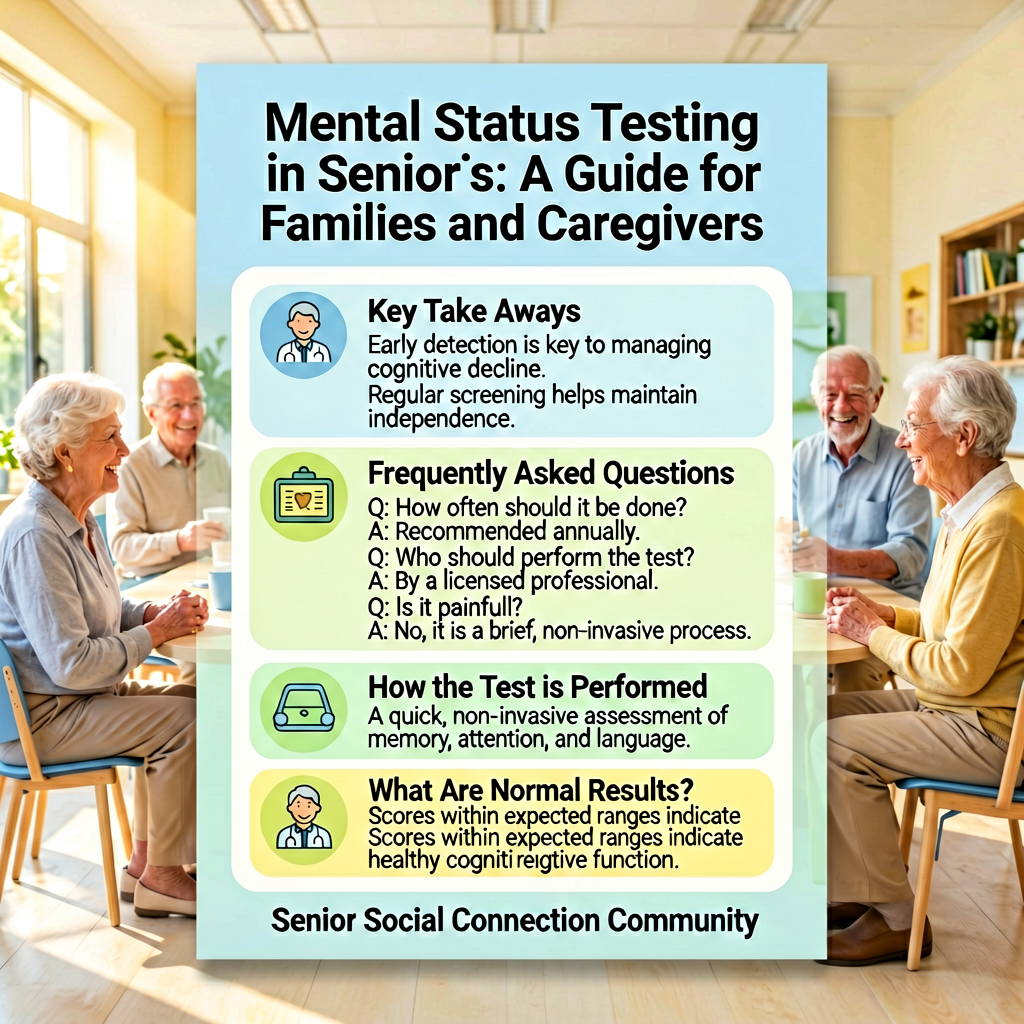

How the Test is Performed?
Your health care provider will ask a number of questions. The test can be done in the home, in an office, nursing home, telehealth visit, or hospital. Sometimes, a psychologist with special training will do more detailed tests.
Common tests used are the:
- Mini-mental state examination (MMSE) or Folstein test
- Montreal cognitive assessment (MoCA)
Mental status testing looks at the following factors:
APPEARANCE
Your provider will check your physical appearance, including:
- Age
- Clothing
- General level of comfort
- Sex
- Grooming
- Height/weight
- Expression
- Posture
- Eye contact
ATTITUDE
- Friendly or hostile
- Cooperative or ambivalent (uncertain)
ORIENTATION
Your provider will ask questions such as:
- What is your name?
- How old are you?
- Where do you work?
- Where do you live?
- What day and time is it?
- What season is it?
PSYCHOMOTOR ACTIVITY
- Are you calm or irritable and anxious
- Do you have a normal expression and body movement (affect) or display a flat and depressed affect
ATTENTION SPAN
Attention span may be tested earlier, because this basic skill can influence the rest of the tests.
Your provider will check:
- Your ability to complete a thought
- Your ability to think and problem solve
- Whether you are easily distracted
You may be asked to do the following:
- Start at a certain number, and then begin to subtract backwards by 7s.
- Spell a word forward and then backward.
- Repeat up to 7 numbers forward, and up to 5 numbers in reverse order.
RECENT AND PAST MEMORY
Your provider will ask questions related to recent people, places, and events in your life or in the world.
You may be shown 3 items and asked to say what they are, and then recall them after 5 minutes.
Your provider will ask about your childhood, school, or events that occurred earlier in life.
LANGUAGE FUNCTION
Your provider will determine if you can express your ideas clearly. Your provider will note if you repeat yourself or repeat what your provider says. Your provider will also find out if you have trouble expressing or understanding (aphasia).
Your provider will point to everyday items in the room and ask you to name them. Or you may be asked to name less common items.
You may be asked to say as many words as possible in one minute that:
- Start with a certain letter
- Are in a certain category
You may be asked to read or write a sentence.
JUDGMENT AND INTELLIGENCE
This part of the test looks at how well you solve a problem or situation. You may be asked questions such as:
- “If you found a driver’s license on the ground, what would you do?”
- “If a police car with lights flashing came up behind your car, what would you do?”
Some tests that screen for language problems do not account for people who do not read or write. If you know that the person being tested cannot read or write, tell the provider before the test.
If your child is having the test, it is important to help them understand the reason for the test.
What Are Normal Results?
Most tests are divided into sections, each with its own score. The results help show which part of someone’s thinking and memory may be affected.
What Abnormal Results Mean?
A number of health conditions can affect mental status. Your provider will discuss these with you. An abnormal mental status test alone does not diagnose the cause. However, doing poorly on such tests can be due to medical illness, brain disease such as dementia , Parkinson disease , or to mental illness. Even when the cause is known, tests may be repeated over time to see if treatment is working.
Mental status exam; Neurocognitive testing; Dementia-mental status testing
Beresin EV, Gordon CD. The psychiatric interview. In: Stern TA, Wilens TE, Fava M, eds.
Massachusetts General Hospital Comprehensive Clinical Psychiatry . 3rd ed. Philadelphia, PA: Elsevier; 2025:chap 2.
DeLuca GC, Griggs RC, Johnston SC. Approach to the patient with neurologic disease. In: Goldman L, Cooney KA, eds.
Goldman-Cecil Medicine . 27th ed. Philadelphia, PA: Elsevier; 2024:chap 366.
Paulsen JS, Gehl C. Neuropsychology. In: Jankovic J, Mazziotta JC, Pomeroy SL, Newman NJ, eds.
Bradley’s and Daroff’s Neurology in Clinical Practice.
8th ed. Philadelphia, PA: Elsevier; 2022:chap 44.
Updated by: Joseph V. Campellone, MD, Department of Neurology, Cooper Medical School at Rowan University, Camden, NJ. Review provided by VeriMed Healthcare Network. Also reviewed by David C. Dugdale, MD, Medical Director, Brenda Conaway, Editorial Director, and the A.D.A.M. Editorial team.
- Alzheimer’s Disease
- Dementia
- Memory
- Mild Cognitive Impairment
- Psychotic Disorders
- Schizophrenia
About the Author: This article was researched and written by the SilverWell Hub editorial team. It was reviewed by the SilverWell Hub editorial team.
Sources: This article is adapted from MedlinePlus, a service of the National Library of Medicine.
Disclaimer: This information is for educational purposes only. See our full Medical Disclaimer.
Published: July 21, 2026