
The kidneys filter the blood and help remove wastes and extra fluid from the body. The kidneys also help control the body’s chemical balance.
The kidneys are part of the urinary system, which also includes the ureters, bladder, and urethra.
Muscle changes and changes in the reproductive system can affect bladder control.
AGING CHANGES AND THEIR EFFECTS ON THE KIDNEYS AND BLADDER
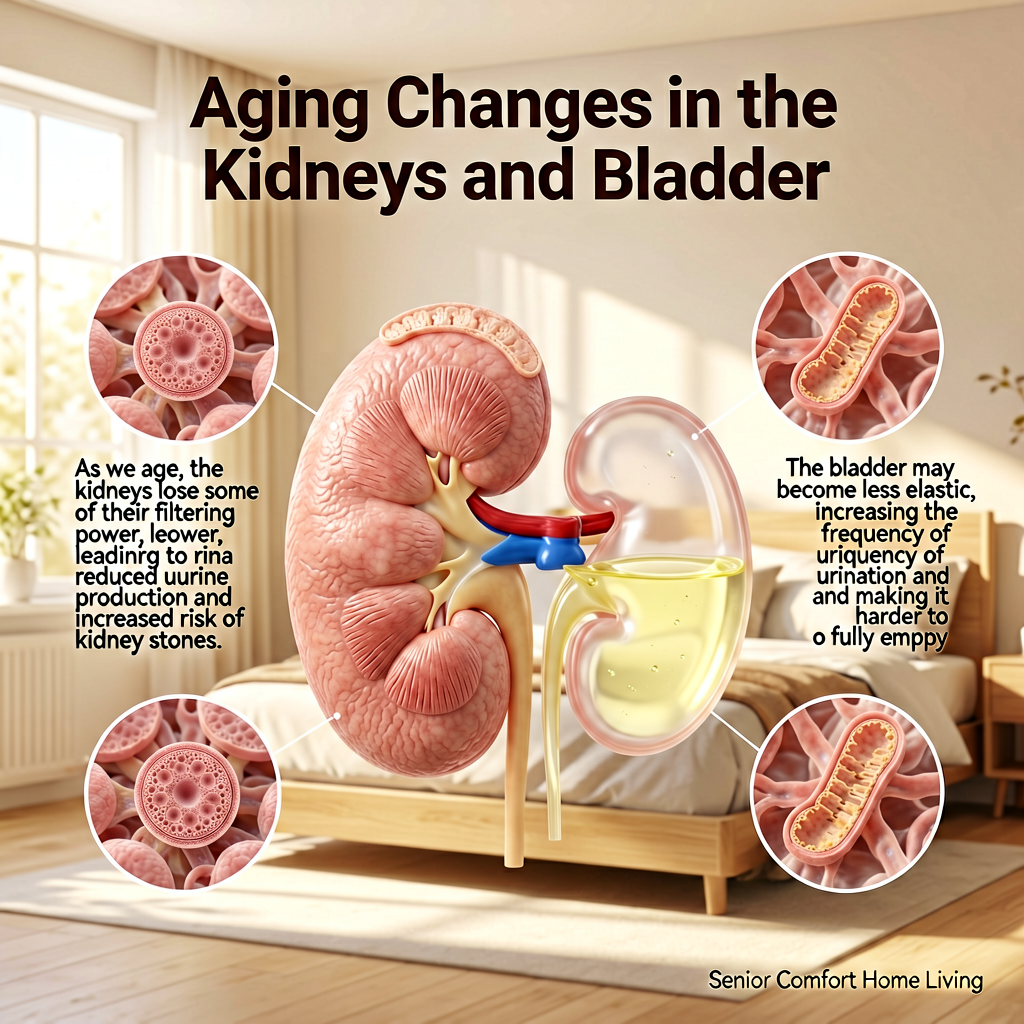
As you age, your kidneys and bladder change. This can affect their function.
Changes in the kidneys that occur with age:
- Amount of kidney tissue decreases and kidney function diminishes.
- Number of filtering units (nephrons) decreases. Nephrons filter waste material from the blood.
- Blood vessels supplying the kidneys can become hardened. This causes the kidneys to filter blood more slowly.
Changes in the bladder:
- The bladder wall changes. The elastic tissue becomes stiffer and the bladder becomes less stretchy. The bladder cannot hold as much urine as before.
- The bladder muscles weaken.
- The urethra can become partially or totally blocked. In women, this can be due to weakened muscles that cause the bladder or vagina to fall out of position (prolapse). In men, the urethra can become blocked by an enlarged prostate gland .
In a healthy aging person, kidney function declines very slowly. Illness, medicines, and other conditions can significantly degrade kidney function.
COMMON PROBLEMS
Aging increases the risk of kidney and bladder problems such as:
- Bladder control issues, such as leakage or urinary incontinence (not being able to hold your urine), or urinary retention (not being able to completely empty your bladder)
- Bladder and other urinary tract infections (UTIs)
- Chronic kidney disease
WHEN TO CONTACT A MEDICAL PROFESSIONAL
Contact your health care provider right away if you have any of the following:
- Signs of a urinary tract infection, including fever or chills, burning when urinating, nausea and vomiting, extreme tiredness, or flank pain
- Very dark urine or fresh blood in the urine
- Trouble urinating
- Urinating more often than usual
(polyuria) - Sudden need to urinate ( urinary urgency )
As you grow older, you will have other changes, including:
- In the bones, muscles, and joints
- In the male reproductive system
- In the female reproductive system
- In organs, tissues, and cells
-
 Changes in kidney with age
 Changes in kidney with age
Griebling TL. Aging and geriatric urology. In: Partin AW, Dmochowski RR, Kavoussi LR, Peters CA, eds.
Campbell-Walsh-Wein Urology . 12th ed. Philadelphia, PA: Elsevier; 2021:chap 128.
Smith PP, Kuchel GA. Aging of the urinary tract. In: Fillit HM, Rockwood K, Young J, eds.
Brocklehurst’s Textbook of Geriatric Medicine and Gerontology . 8th ed. Philadelphia, PA: Elsevier; 2017:chap 22.
Walston JD. Common clinical sequelae of aging. In: Goldman L, Cooney KA, eds.
Goldman-Cecil Medicine . 27th ed. Philadelphia, PA: Elsevier; 2024:chap 24.
Updated by: Frank D. Brodkey, MD, FCCM, Associate Professor, Section of Pulmonary and Critical Care Medicine, University of Wisconsin School of Medicine and Public Health, Madison, WI. Also reviewed by David C. Dugdale, MD, Medical Director, Brenda Conaway, Editorial Director, and the A.D.A.M. Editorial team.
- Kidney Diseases
- Older Adult Health
About the Author: This article was researched and written by the SilverWell Hub editorial team. It was reviewed by the SilverWell Hub editorial team.
Sources: This article is adapted from MedlinePlus, a service of the National Library of Medicine.
Disclaimer: This information is for educational purposes only. See our full Medical Disclaimer.
Published: July 21, 2026