

Multiple sclerosis (MS) is an
autoimmune disease
that affects the
brain and spinal cord
(central nervous system).
What Are the Common Causes and Risk Factors?
MS affects women more often than men. The disease is most commonly diagnosed between ages 20 to 40, but it can be seen at any age.
Key Takeaways
- What Are the Common Causes and Risk Factors?
- What Are the Symptoms and Warning Signs?
- What Are Exams and Tests?
- How Is It Treated?
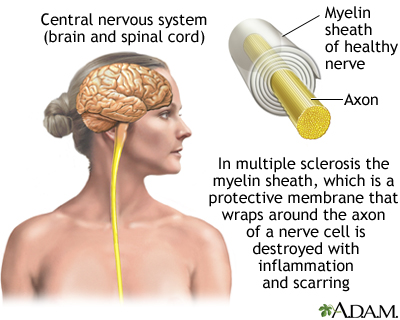
MS is caused by damage to the myelin sheath of nerves. This sheath is the protective covering that surrounds nerve cells. When this nerve covering is damaged, nerve signals slow or stop.
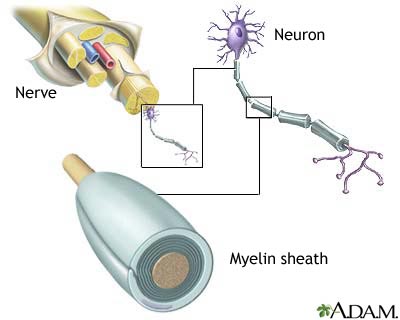
The nerve damage is caused by inflammation. Inflammation occurs when the body’s immune cells attack the nervous system. This can occur along any area of the brain, optic nerve, and spinal cord.
It is unknown what exactly causes MS. The most common thought is that it is caused by a virus, a variant gene, or both. Environmental factors may also play a role.
You are slightly more likely to develop this condition if you have a family history of MS or you live in a part of the world where MS is more common (areas further from the equator).
What Are the Symptoms and Warning Signs?
Symptoms vary because the location and severity of each attack can be different. Attacks can last for days, weeks, or months. Attacks are followed by remissions. These are periods of reduced symptoms or no symptoms. Fever, hot baths, sun exposure, and stress can trigger or worsen attacks.
Nerves in any part of the brain or spinal cord may be damaged. Because of this, MS symptoms can appear in many parts of the body.
Muscle symptoms:
- Loss of balance
- Muscle spasms
- Numbness
or abnormal sensation in any area - Problems moving arms or legs
- Problems walking
- Problems with coordination and making small movements
- Tremor
in one or more arms or legs - Weakness
in one or more arms or legs
Bowel and bladder symptoms:
- Constipation
and stool leakage - Difficulty beginning to urinate
- Frequent need to urinate
- Strong urge to urinate
- Urine leakage
(incontinence)
Eye symptoms:
- Double vision
- Eye discomfort
- Uncontrollable eye movements
- Vision loss
(usually affects one eye at a time)
Numbness, tingling, or pain:
- Facial pain
-
Painful
muscle spasms - Tingling, crawling, or burning feeling in the arms and legs
Other brain and nerve symptoms:
- Decreased attention span, poor judgment, and memory loss
- Difficulty reasoning and solving problems
- Depression
or feelings of sadness - Dizziness
and balance problems - Hearing loss
Sexual symptoms:
- Problems with erections
- Problems with vaginal lubrication
Speech and swallowing symptoms:
- Slurred
or difficult-to-understand speech - Trouble chewing and swallowing
Fatigue
is a common and bothersome symptom as MS progresses. It is often worse in the late afternoon.
📖 What Are Exams and Tests?
What Are Exams and Tests?
Symptoms of MS may mimic those of many other nervous system problems. MS is diagnosed by determining if there are signs of more than one attack on the brain or spinal cord and by checking for other conditions.
People who have a form of MS called relapsing-remitting MS have evidence of at least two attacks separated by a remission.
In other people, the disease may slowly get worse in between clear attacks. This form is called secondary progressive MS. A form with gradual progression, but no clear attacks is called primary progressive MS.
Your health care provider may suspect MS if there are decreases in the function of two different parts of the central nervous system (such as abnormal reflexes) at two different times.
An exam of the nervous system may show reduced nerve function in one area of the body. Or the reduced nerve function may be spread over many parts of the body. This may include:
- Abnormal nerve reflexes
- Decreased ability to move a part of the body
- Decreased or abnormal sensation
- Other loss of nervous system functions, such as vision
An eye exam may show:
- Abnormal pupil responses
-
Changes in the
visual fields - Changes in eye movements
- Damage to the nerve in the eye ( optic nerve atrophy )
- Decreased visual acuity
- Problems with the inside parts of the eye
- Rapid eye movements triggered when the eye moves
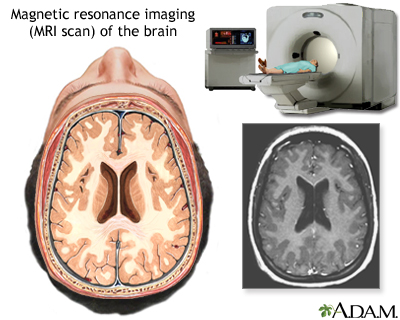
Tests to diagnose MS include:
- Blood tests to check for other conditions that are similar to MS.
- Lumbar puncture
(spinal tap) for cerebrospinal fluid (CSF) tests, including CSF oligoclonal banding may be needed. - MRI scan of the brain
, or the spine, or both are important to help diagnose and follow the progress of MS. - Nerve function study (evoked potential test, such as visual evoked response) is less often used.
📖 How Is It Treated?
How Is It Treated?
There is no known cure for MS at this time, but there are treatments that may slow the disease. The goal of treatment is to stop progression, control symptoms, and help you maintain a normal quality of life.
Medicines are often taken long-term. These include:
- Medicines to slow the disease
- Steroids to decrease the severity of attacks (more effective for relapsing-remitting form of MS than for other forms)
- Other medicines are used to control symptoms such as muscle spasms, urinary problems, fatigue, or mood problems
The following may also be
helpful for people with MS
:
- Physical therapy, speech therapy, occupational therapy, and support groups
- Assistive devices, such as wheelchairs, bed lifts, shower chairs, walkers, and wall bars
- A planned exercise program early in the course of the disease
- A healthy lifestyle, with good nutrition and enough rest and relaxation
- Avoiding fatigue, stress, temperature extremes, and illness
-
Changes in
what you eat or drink if there are swallowing problems -
Making changes around the home to
prevent falls - Social workers or other counseling services to help you cope with the disease and get assistance
- Vitamin D or other supplements (talk to your provider first)
- Complementary and alternative approaches, such as acupuncture or cannabis, to help with muscle problems
- Spinal devices can reduce pain and spasticity in the legs
📖 What Are Support Groups?
What Are Support Groups?
Living with MS may be a challenge. You can ease the stress of illness by joining an
MS support group
. Sharing with others who have common experiences and problems can help you not feel alone.
📖 What Is Outlook (Prognosis)?
What Is Outlook (Prognosis)?
The outcome varies, and is hard to predict. Although the disorder is life-long (
chronic
) and incurable, life expectancy can be normal or almost normal. Most people with MS are active and function at work with little disability.
Those who usually have the best outlook are:
- Females
- People who were young (less than 30 years old) when the disease started
- People with infrequent attacks
- People with a relapsing-remitting pattern
- People who have limited disease on imaging studies
The amount of disability and discomfort depends on:
- How often and severe the attacks are
- The part of the central nervous system that is affected by each attack
Most people return to normal or near-normal function between attacks. Over time, there is greater loss of function with less improvement between attacks.
📖 What Are Possible Complications?
What Are Possible Complications?
MS may lead to the following:
- Depression
- Difficulty swallowing
- Difficulty thinking
- Less and less ability to care for self
-
Need for
indwelling urinary catheter - Osteoporosis
or thinning of the bones - Pressure sores
- Side effects of medicines used to treat the disorder
- Urinary tract infections
📖 When to Contact a Medical Professional?
When to Contact a Medical Professional?
Contact your provider if:
- You develop any symptoms of MS
- Your symptoms get worse, even with treatment
- The condition worsens to the point when home care is no longer possible
MS; Demyelinating disease
📖 What Are Patient Instructions?
What Are Patient Instructions?
- Caring for muscle spasticity or spasms
- Constipation – self-care
- Daily bowel care program
- Multiple sclerosis – discharge
- Preventing pressure ulcers
- Swallowing problems
-
 Multiple sclerosis
 -
 MRI of the brain
 -
 Central nervous system and peripheral nervous system
 -
 Myelin and nerve structure
 -
 Nerve supply to the pelvis
 Multiple sclerosis
 MRI of the brain
 Central nervous system and peripheral nervous system
 Myelin and nerve structure
 Nerve supply to the pelvis
Calabresi PA. Multiple sclerosis and demyelinating conditions of the central nervous system. In: Goldman L, Cooney KA, eds.
Goldman-Cecil Medicine
. 27th ed. Philadelphia, PA: Elsevier; 2024:chap 380.
Fabian MT, Krieger SC, Lublin FD. Multiple sclerosis and other inflammatory demyelinating diseases of the central nervous system. In: Jankovic J, Mazziotta JC, Pomeroy SL, Newman NJ, eds.
Bradley and Daroff’s Neurology in Clinical Practice
. 8th ed. Philadelphia, PA: Elsevier; 2022:chap 80.
Rae-Grant A, Day GS, Marrie RA, et al. Practice guideline recommendations summary: disease-modifying therapies for adults with multiple sclerosis: report of the Guideline Development, Dissemination, and Implementation Subcommittee of the American Academy of Neurology.
Neurology.
2018;90(17):777-788. PMID: 29686116
pubmed.ncbi.nlm.nih.gov/29686116/
.
Updated by: Joseph V. Campellone, MD, Department of Neurology, Cooper Medical School at Rowan University, Camden, NJ. Review provided by VeriMed Healthcare Network. Also reviewed by David C. Dugdale, MD, Medical Director, Brenda Conaway, Editorial Director, and the A.D.A.M. Editorial team.
- Multiple Sclerosis
Frequently Asked Questions
What Are the Common Causes and Risk Factors?
What Are the Symptoms and Warning Signs?
What Are Exams and Tests?
How Is It Treated?
What Are Support Groups?
About the Author: This article was researched and written by the SilverWell Hub editorial team. It was reviewed by the SilverWell Hub editorial team.
Sources: This article is adapted from MedlinePlus, a service of the National Library of Medicine (NLM/NIH).
Disclaimer: This information is for educational purposes only. See our full Medical Disclaimer.
Published: July 28, 2026