
Key Takeaways
- What Are the Common Causes and Risk Factors?
What Are the Common Causes and Risk Factors?
Understanding sleep disorders seniors insomnia aging wellness treatment is important for seniors and their caregivers. there are more than 100 different sleep disorders. They can be grouped into four main categories:
- Problems falling or staying asleep ( insomnia )
- Problems staying awake (excessive daytime sleepiness)
- Problems sticking to a regular sleep schedule (sleep rhythm problem)
- Unusual behaviors during sleep (sleep-disruptive behaviors)
PROBLEMS FALLING AND STAYING ASLEEP
Insomnia includes trouble falling asleep or staying asleep. Episodes may come and go, last up to 3 weeks (be short-term), or be long-lasting (chronic).
PROBLEMS STAYING AWAKE
Hypersomnia
is a condition in which people have excessive daytime sleepiness. This means they feel tired during the day and are prone to falling asleep. Hypersomnia can also include situations in which a person needs to sleep a lot. This may be due to other medical conditions, but can also be due to a problem in the brain. Causes of this problem include:
- Medical conditions, such as fibromyalgia and low thyroid function
- Medicines that are sedating
- Mononucleosis
or other viral illnesses - Narcolepsy
and other sleep disorders - Obesity , especially if it causes obstructive sleep apnea
When no cause for the sleepiness can be found, it is called
idiopathic hypersomnia
.
PROBLEMS STICKING TO A REGULAR SLEEP SCHEDULE
Problems may also occur when you do not stick to a regular sleep and wake schedule. This occurs when people travel between time zones. It can also occur with shift workers who are on changing schedules, especially nighttime workers.
Disorders that involve a disrupted sleep schedule include:
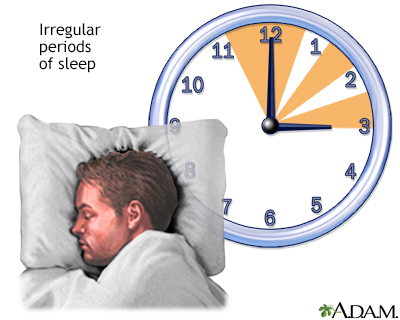
- Irregular sleep-wake syndrome
- Jet lag syndrome
- Shift work sleep disorder
- Delayed sleep phase, as in teenagers who go to sleep very late at night and then sleep until noon
- Advanced sleep phase, as in older adults who go to sleep early in the evening and wake up very early
SLEEP-DISRUPTIVE BEHAVIORS
Abnormal behaviors during sleep are called parasomnias. They are fairly common in children and include:
- Sleep terrors
- Sleepwalking
- REM sleep-behavior disorder (a person moves during REM sleep and may act out dreams)
Insomnia; Narcolepsy; Hypersomnia; Daytime sleepiness; Sleep rhythm; Sleep disruptive behaviors; Jet lag
-
 Irregular sleep
 -
 Sleep patterns in the young and aged
 Irregular sleep
 Sleep patterns in the young and aged
Avidan AY. Sleep and its disorders. In: Jankovic J, Mazziotta JC, Pomeroy SL, Newman NJ, eds.
Bradley and Daroff’s Neurology in Clinical Practice
. 8th ed. Philadelphia, PA: Elsevier; 2022:chap 101.
Owens JA, Gueye-Ndiaye S. Sleep medicine. In: Kliegman RM, St. Geme JW, Blum NJ, et al, eds.
Nelson Textbook of Pediatrics
. 22nd ed. Philadelphia, PA: Elsevier; 2025:chap 31.
Sateia MJ, Thorpy MJ. Classification of sleep disorders. In: Kryger M, Roth T, Goldstein CA, Dement WC, eds.
Principles and Practice of Sleep Medicine
. 7th ed. Philadelphia, PA: Elsevier; 2022:chap 69.
Vaughn BV, Basner RC. Sleep disorders. In: Goldman L, Cooney KA, eds.
Goldman-Cecil Medicine
. 27th ed. Philadelphia, PA: Elsevier; 2024:chap 374.
Updated by: Allen J. Blaivas, DO, Division of Pulmonary, Critical Care, and Sleep Medicine, VA New Jersey Health Care System, Clinical Assistant Professor, Rutgers New Jersey Medical School, East Orange, NJ. Review provided by VeriMed Healthcare Network. Also reviewed by David C. Dugdale, MD, Medical Director, Brenda Conaway, Editorial Director, and the A.D.A.M. Editorial team.
- Sleep Disorders
About the Author: This article was researched and written by the SilverWell Hub editorial team. It was reviewed by the SilverWell Hub editorial team.
Sources: This article is adapted from MedlinePlus, a service of the National Library of Medicine (NLM/NIH).
Disclaimer: This information is for educational purposes only. See our full Medical Disclaimer.
Published: July 28, 2026