

What Are the Common Causes and Risk Factors?
Sleep problems are common in older adults. The amount of sleep needed stays constant throughout the adult years. Doctors recommend that adults get 7 to 8 hours of sleep each night. In older adults, sleep is less deep and choppier than sleep in younger people.
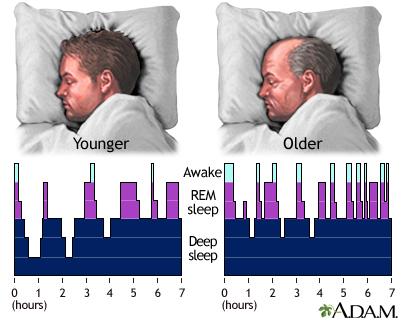
A healthy 70-year-old may wake up several times during the night without it being due to disease.
Sleep disturbances in older adults may be due to any of the following:
- Alzheimer disease
- Alcohol use
- Changes in the body’s natural internal clock, causing some people to fall asleep earlier in the evening
-
Long-term (chronic) disease, such as
heart failure - Certain medicines, herbs, supplements, and recreational drugs
- Depression
(depression is a common cause of sleep problems in people of all ages) - Brain and nervous system conditions
- Not being very active
-
Pain caused by diseases such as
arthritis - Stimulants such as caffeine and nicotine
- The need to urinate at night ( nocturia )
What Are the Symptoms and Warning Signs?

Symptoms that may occur include:
- Difficulty falling asleep
- Difficulty telling the difference between night and day
- Early morning awakening
- Waking up often during the night (for example, due to nocturia)
📖 What Are Exams and Tests?
What Are Exams and Tests?
The health care provider will take a history and perform a physical exam to look for medical causes and determine which type of sleep disorder is causing the problem.
Your provider may recommend you create a sleep diary or that you have a sleep study (polysomnography).
📖 How Is It Treated?
How Is It Treated?
Relieving chronic pain and controlling medical conditions such as nocturia or frequent urination may improve sleep in some people. Treating depression will often improve sleep.
Sleeping in a quiet room that isn’t too hot or too cold and having a relaxing bedtime routine may help improve symptoms. Other ways to promote sleep include these healthy lifestyle tips:
- Avoid large meals shortly before bedtime. A light bedtime snack may be helpful. Many people find that warm milk increases sleepiness, because it contains a natural, sedative-like amino acid.
- Avoid stimulants such as caffeine for at least 3 or 4 hours before bed.
- Exercise at regular times each day, but not within 3 hours of your bedtime.
- Go to bed and wake up at the same time every day.
- Do not take naps.
- Do not watch television or use your computer, cell phone, or tablet in the bedroom.
- Avoid tobacco products, especially before sleep.
- Use the bed only for sleep or sexual activity.
If you can’t fall asleep after 20 minutes, get out of bed and do a quiet activity such as reading or listening to music.
Avoid using sleeping pills to help you sleep, if possible. They can lead to dependence and can make sleep problems worse over time if you don’t use them the right way. Your provider should assess your risks of daytime sleepiness, mental (cognitive) side effects, and falls before you begin taking sleep medicines.
- If you think you need sleeping pills, talk with your provider about which pills are safe for you when taken properly. Certain sleeping pills should not be taken on a long-term basis.
- Do not drink alcohol at any time when you are using sleeping pills. Alcohol can make the side effects of all sleeping pills worse.
WARNING: The FDA has asked manufacturers of certain sleep medicines to put stronger warning labels on their products so that consumers are more aware of the potential risks. Possible risks while taking such medicines include severe allergic reactions and dangerous sleep-related behaviors, including sleep-driving. Ask your provider about these risks.
📖 What Is Outlook (Prognosis)?
What Is Outlook (Prognosis)?

For most people, sleep improves with treatment. However, others may continue to have sleep disruptions.
📖 What Are Possible Complications?
What Are Possible Complications?
Possible complications are:
- Alcohol use
- Drug use
- Increased risk for falls (due to frequent urination at night)
📖 When to Contact a Medical Professional?
When to Contact a Medical Professional?
Contact your provider for an appointment if a lack of sleep or too much sleep is interfering with daily living.
📖 How Is It Prevented?
How Is It Prevented?
Getting regular exercise and avoiding as many causes of sleep disruption as possible and adequate exposure to natural light may help control sleep problems.
Insomnia – older adults
-
 Sleep patterns in the young and aged
 Sleep patterns in the young and aged
Avidan AY. Sleep and its disorder. In: Jankovic J, Mazziotta JC, Pomeroy SL, Newman NJ, eds.
Bradley and Daroff’s Neurology in Clinical Practice . 8th ed. Philadelphia, PA: Elsevier; 2022:chap 101.
Miner B, Lucey BP. Normal aging. In: Kryger M, Roth T, Goldstein CA, Dement WC, eds.
Principles and Practice of Sleep Medicine . 7th ed. Philadelphia, PA: Elsevier; 2022:chap 3.
National Institute on Aging website. A good night’s sleep.
www.nia.nih.gov/health/good-nights-sleep . Updated November 3, 2020. Accessed September 13, 2024.
Shochat T, Ancoli-Israel S. Insomnia in older adults. In: Kryger M, Roth T, Goldstein CA, Dement WC, eds.
Principles and Practice of Sleep Medicine . 7th ed. Philadelphia, PA: Elsevier; 2022:chap 193.
Sterniczuk R, Rusak B. Sleep in relation to aging, frailty, and cognition. In: Fillit HM, Rockwood K, Young J, eds.
Brocklehurst’s Textbook of Geriatric Medicine and Gerontology . 8th ed. Philadelphia, PA: Elsevier; 2017:chap 108.
Updated by: Allen J. Blaivas, DO, Division of Pulmonary, Critical Care, and Sleep Medicine, VA New Jersey Health Care System, Clinical Assistant Professor, Rutgers New Jersey Medical School, East Orange, NJ. Review provided by VeriMed Healthcare Network. Also reviewed by David C. Dugdale, MD, Medical Director, Brenda Conaway, Editorial Director, and the A.D.A.M. Editorial team.
- Sleep Disorders
Frequently Asked Questions
Key Takeaways
The health care provider will take a history and perform a physical exam to look for medical causes and determine which type of sleep disorder is causing the problem. Relieving chronic pain and controlling medical conditions such as nocturia or frequent urination may improve sleep in some people.
What Are the Common Causes and Risk Factors?
What Are the Symptoms and Warning Signs?
Difficulty falling asleep Difficulty telling the difference between night and day Early morning awakening Waking up often during the night (for example, due to nocturia) 📖 What Are Exams and Tests?
What Are Exams and Tests?
How Is It Treated?
About the Author: This article was researched and written by the SilverWell Hub editorial team. It was reviewed by the SilverWell Hub editorial team.
Sources: This article is adapted from MedlinePlus, a service of the National Library of Medicine.
Disclaimer: This information is for educational purposes only. See our full Medical Disclaimer.
Published: July 19, 2026