

What Are the Common Causes and Risk Factors?
The actual cause of prostate enlargement is unknown. Factors linked to aging and changes in the cells of the testicles may have a role in the growth of the gland, as well as testosterone levels. Men who have had their testicles removed at a young age (for example, as a result of testicular cancer) do not develop BPH.
Also, if the testicles are removed after a man develops BPH, the prostate begins to shrink in size. However, this is not a standard treatment for an enlarged prostate.
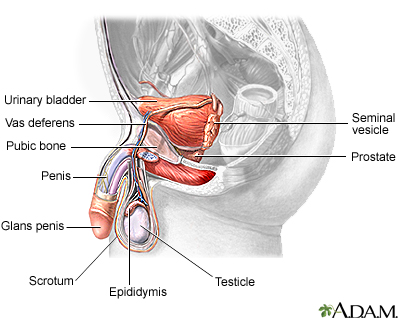
Some facts about prostate enlargement:
- The likelihood of developing an enlarged prostate increases with age.
- BPH is so common that it has been said all men will have an enlarged prostate if they live long enough.
- A small amount of prostate enlargement is present in many men over age 40. More than 90% of men over age 80 have the condition.
- No risk factors have been identified, other than having normally-functioning testicles.
What Are the Symptoms and Warning Signs?

Less than half of all men with BPH have symptoms of the disease. Symptoms may include:
- Dribbling at the end of urinating
- Inability to urinate (urinary retention)
- Incomplete emptying of your bladder
- Incontinence
- Needing to urinate 2 or more times per night
- Pain with urination or bloody urine (these may indicate infection)
- Slowed or delayed start of the urinary stream
- Straining to urinate
- Strong and sudden urge to urinate
- Weak urine stream
📖 What Are Exams and Tests?
What Are Exams and Tests?
Your health care provider will ask questions about your medical history. A digital rectal exam will also be done to feel the prostate gland. Other tests may include:
- Urine flow rate
- Post-void residual urine test to see how much urine is left in your bladder after you urinate (usually done by ultrasound)
- Pressure-flow studies to measure the pressure in the bladder as you urinate
- Urinalysis
to check for blood or infection - Urine culture
to check for infection - Prostate-specific antigen ( PSA ) blood test to screen for prostate cancer
- Cystoscopy
- Blood urea nitrogen (BUN)
and creatinine tests to check for reduced kidney function
You may be asked to fill out a form to rate how bad your symptoms are and how much they affect your daily life. Your provider can use this score to judge if your condition is getting worse over time.
📖 How Is It Treated?
How Is It Treated?
The treatment you choose will be based on how bad your symptoms are and how much they bother you. Your provider will also take into account other medical problems you may have.
Treatment options include “watchful waiting,” lifestyle changes, medicines, or surgery.
If you are over 60, you are more likely to have symptoms. But many men with an enlarged prostate have only minor symptoms. Self-care steps are often enough to make you feel better.
If you have BPH, you should have a yearly assessment to monitor your symptoms and see if you need changes in treatment.
SELF-CARE
For mild symptoms:
- Urinate when you first get the urge. Also, go to the bathroom on a timed schedule, even if you don’t feel a need to urinate.
- Avoid alcohol and caffeine, especially after dinner.
- Do not drink a lot of fluid all at once. Spread out fluids during the day. Avoid drinking fluids within 2 hours of bedtime.
- Try not to take over-the-counter cold and sinus medicines that contain decongestants or antihistamines. These medicines can increase BPH symptoms.
- Keep warm and exercise regularly. Cold weather and lack of physical activity may worsen symptoms.
- Reduce stress. Nervousness and tension can lead to more frequent urination.
MEDICINES
Alpha-1 blockers are a class of medicines, some of which have been used to treat high blood pressure. These medicines relax the muscles of the bladder neck and prostate. This allows easier urination. Most people who take alpha-1 blockers notice improvement in their symptoms, usually within 3 to 7 days after starting the medicine.
Finasteride and dutasteride lower levels of hormones produced by the prostate. These medicines also reduce the size of the gland, increase urine flow rate, and decrease symptoms of BPH. You may need to take these medicines for 3 to 6 months before you notice symptoms getting better. Possible side effects include decreased sex drive and impotence .
Antibiotics may be prescribed to treat chronic prostatitis (inflammation of the prostate), which may occur with BPH. BPH symptoms may improve in some men after a course of antibiotics.
Watch out for medicines that may make your symptoms worse such as decongestants, antihistamines, diuretics, and certain antidepressants.
SAW PALMETTO
Many herbs have been tried for treating an enlarged prostate. Many men use saw palmetto to ease symptoms. Some studies have shown that it may help with symptoms, but results are mixed, and more research is needed. If you use saw palmetto and think it works, ask your provider if you should still take it.
SURGERY
Prostate surgery may be recommended if you have:
- Incontinence
- Recurrent blood in the urine
- Inability to fully empty the bladder (urinary retention)
-
Recurrent
urinary tract infections - Decreasing kidney function
- Bladder stones
- Bothersome symptoms not responding to medicines
The choice of which surgical procedure is recommended is most often based on the severity of your symptoms and the size and shape of your prostate gland. Most men who have prostate surgery have improvement in urine flow rates and symptoms.
Transurethral resection of the prostate (TURP): This is the most common and most proven surgical treatment for BPH. TURP is performed by inserting a scope through the penis and removing the prostate piece by piece.
Simple prostatectomy : This is a procedure to remove the inside part of the prostate gland. It is done through a surgical cut in your lower belly. This treatment is most often done on men who have very large prostate glands.
Other less-invasive procedures use heat or a laser to destroy prostate tissue. Another less-invasive procedure works by “tacking” the prostate open without removing or destroying tissues. None have been proven to be better than TURP. People who receive these procedures are more likely to need surgery again after 5 or 10 years. However, these procedures may be a choice for:
- Younger men (many of the less-invasive procedures carry a lower risk for impotence and incontinence than TURP, although the risk with TURP is not very high)
- Older people
- People with severe medical conditions, including uncontrolled diabetes , cirrhosis , alcoholism, psychosis , and serious lung, kidney, or heart disease
- Men who are taking blood-thinning medicines
- Men who are otherwise at an increased surgical risk
📖 What Are Support Groups?

📖 What Are Possible Complications?
What Are Possible Complications?
Men who have had BPH for long time with slowly worsening symptoms may develop:
- Sudden inability to urinate (urinary retention)
- Urinary tract infections
- Urinary stones
- Damage to the kidneys
- Blood in the urine
BPH may come back over time, even after having surgery.
📖 When to Contact a Medical Professional?
When to Contact a Medical Professional?
Contact your provider right away if you have:
- Less urine than usual
- Fever or chills
- Back, side, or abdominal pain
- Blood or pus in your urine
Also contact your provider if:
- Your bladder does not feel completely empty after you urinate.
- You take medicines that may cause urinary problems, such as diuretics, antihistamines, antidepressants, or sedatives. Do not stop or change your medicines without talking to your provider.
- You have tried self-care steps for 2 months and symptoms have not improved.
BPH; Benign prostatic hyperplasia (hypertrophy); Prostate – enlarged
📖 What Are Patient Instructions?
What Are Patient Instructions?
- Enlarged prostate – what to ask your doctor
- Prostate resection – minimally invasive – discharge
- Transurethral resection of the prostate – discharge
-
 Male reproductive anatomy
 -
 BPH
BPH -
 Transurethral resection of the prostate (TURP) – Series
 -
 Enlarged prostate gland
 Male reproductive anatomy
 BPH
BPH Transurethral resection of the prostate (TURP) – Series
 Enlarged prostate gland
Capogrosso P, Pozzi E, Salonia A, Montorsi F. Evaluation and nonsurgical management of benign prostatic hyperplasia. In: Domochowski RR, Kavoussi LR, Peters CA, et al, eds.
Campbell-Walsh-Wein Urology . 13th ed. Philadelphia, PA: Elsevier; 2026:chap 150.
Cruz F, Michel MC, Igawa Y. Pharmacologic management of lower urinary tract storage and emptying failure. In: Domochowski RR, Kavoussi LR, Peters CA, et al, eds.
Campbell-Walsh-Wein Urology . 13th ed. Philadelphia, PA: Elsevier; 2026:chap 113.
Kaplan SA. Benign prostatic hyperplasia and prostatitis. In: Goldman L, Cooney KA, eds.
Goldman-Cecil Medicine . 27th ed. Philadelphia, PA: Elsevier; 2024:chap 114.
National Institute of Diabetes and Digestive and Kidney Diseases website. Enlarged prostate (benign prostatic hyperplasia).
www.niddk.nih.gov/health-information/urologic-diseases/prostate-problems/prostate-enlargement-benign-prostatic-hyperplasia . Updated June 2024. Accessed July 2, 2025.
Sandhu JS, Bixler BR, Dahm P, et al. Management of lower urinary tract symptoms attributed to benign prostatic hyperplasia (BPH): AUA Guideline Amendment 2023.
J Urol . 2024;211(1):11-19. PMID: 37706750 pubmed.ncbi.nlm.nih.gov/37706750/ .
Updated by: Kelly L. Stratton, MD, FACS, Associate Professor, Department of Urology, University of Oklahoma Health Sciences Center, Oklahoma City, OK. Also reviewed by David C. Dugdale, MD, Medical Director, Brenda Conaway, Editorial Director, and the A.D.A.M. Editorial team.
- Enlarged Prostate (BPH)
Frequently Asked Questions
Key Takeaways
What Are the Common Causes and Risk Factors?
What Are the Symptoms and Warning Signs?
Dribbling at the end of urinating Inability to urinate (urinary retention) Incomplete emptying of your bladder Incontinence Needing to urinate 2 or more times per night Pain with urination or bloody urine (these may indicate infection) Slowed or delayed start of the urinary stream Straining to urinate Strong and sudden urge to urinate Weak urine stream 📖 What Are Exams and Tests?
What Are Exams and Tests?
Urine flow rate Post-void residual urine test to see how much urine is left in your bladder after you urinate (usually done by ultrasound) Pressure-flow studies to measure the pressure in the bladder as you urinate Urinalysis to check for blood or infection Urine culture to check for infection Prostate-specific antigen ( PSA ) blood test to screen for prostate cancer Cystoscopy Blood urea nitrogen (BUN) and creatinine tests to check for reduced kidney function You may be asked to fill out a form to rate how bad your symptoms are and how much they affect your daily life.
How Is It Treated?
About the Author: This article was researched and written by the SilverWell Hub editorial team. It was reviewed by the SilverWell Hub editorial team.
Sources: This article is adapted from MedlinePlus, a service of the National Library of Medicine.
Disclaimer: This information is for educational purposes only. See our full Medical Disclaimer.
Published: July 19, 2026