

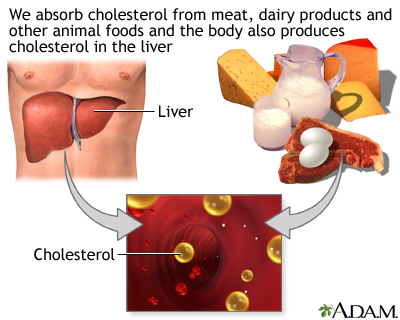
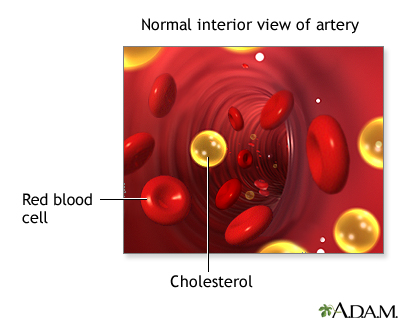
Cholesterol is a fat (also called a lipid) that your body needs to work properly. Too much bad cholesterol in your blood can increase your chance of getting heart disease , stroke , and other problems.
Common medical terms for high blood cholesterol are lipid disorder, hyperlipidemia, or hypercholesterolemia, with the last being the most precise.
What Are the Common Causes and Risk Factors?
There are many types of cholesterol. The ones talked about most are:
- Total cholesterol — all the cholesterols combined
- High density lipoprotein (HDL) cholesterol — often called good cholesterol
- Low density lipoprotein (LDL) cholesterol — often called bad cholesterol
For many people, abnormal cholesterol levels are partly due to lifestyle choices . This often includes eating a diet that is high in fat . Other lifestyle factors are:
-
Being
overweight - Lack of exercise
Some health conditions can also lead to abnormal cholesterol, including:
- Diabetes
- Kidney disease
- Polycystic ovary syndrome
- Pregnancy and other conditions that increase levels of female hormones
- Underactive thyroid gland
Medicines such as certain birth control pills, diuretics (water pills), beta-blockers, and some medicines used to treat depression may also raise cholesterol levels. Several disorders that are passed down through families lead to abnormal cholesterol and triglyceride levels. They include:
- Familial combined hyperlipidemia
- Familial dysbetalipoproteinemia
- Familial hypercholesterolemia
- Familial hypertriglyceridemia
Smoking does not cause higher cholesterol levels, but it can reduce your HDL (good) cholesterol.
What Are Exams and Tests?

A cholesterol test is done to diagnose a lipid disorder. Different experts recommend different starting ages for adults.
- Recommended starting ages are between 20 to 35 for men and 20 to 45 for women.
- Adults with normal cholesterol levels should have the test repeated every 5 years.
- Repeat testing sooner if changes occur in lifestyle (including weight gain and diet).
- Adults with a history of elevated cholesterol, diabetes, kidney problems, heart disease, and other conditions require more frequent testing.
It is important to work with your health care provider to set your cholesterol goals. Newer guidelines steer providers away from targeting specific levels of cholesterol. Instead, they recommend different treatments or medicines and doses depending on a person’s history and risk factor profile. These guidelines change from time to time as more information from research studies becomes available.
General targets are:
- LDL: Less than 100 mg/dL (2.59 mmol/L) – lower numbers are better
- HDL: 60 mg/dL (1.55 mmol/L) or higher – higher numbers are better
- Total cholesterol: Less than 200 mg/dL (5.18 mmol/L) – lower numbers are better
- Triglycerides: Less than 150 mg/dL (1.69 mmol/L) – lower numbers are better
If your cholesterol results are abnormal, you may also have other tests such as:
- Blood sugar (glucose) test
to look for diabetes - Kidney function tests
- Thyroid function tests
to look for an underactive thyroid gland
📖 How Is It Treated?
How Is It Treated?
Steps you can take to improve your cholesterol levels and to help prevent heart disease and a heart attack include:
- Quit smoking
. This is the single biggest change you can make to reduce your risk of heart attack and stroke. - Eat foods that are naturally low in fat. These include whole grains, fruits, and vegetables.
- Use low-fat toppings, sauces, and dressings.
- Avoid foods that are high in saturated fat .
- Exercise regularly.
- Lose weight if you are overweight.
Your provider may want you to take medicine for your cholesterol if lifestyle changes do not work. This will depend on:
- Your age
- Whether or not you have heart disease, diabetes, or other blood vessel problems
- Whether you smoke or are overweight
- Whether you have high blood pressure or diabetes
You are more likely to need medicine to lower your cholesterol :
- If you have heart disease or diabetes
- If you are at high risk for heart disease (even if you do not yet have any heart problems)
- If your LDL cholesterol is 190 mg/dL (4.92 mmol/L) or higher
Almost everyone else may get health benefits from LDL cholesterol that is lower than 160 to 190 mg/dL (4.14 mmol/L to 4.92 mmol/L).
There are several types of medicines to help lower blood cholesterol levels. The medicines work in different ways. Statins are one kind of drug that lowers cholesterol and has been proven to reduce the chance of heart disease. Other medicines are available if your risk is high and statins do not lower your cholesterol levels enough. These include ezetimibe and PCSK9 inhibitors.
📖 What Is Outlook (Prognosis)?
What Is Outlook (Prognosis)?
High cholesterol levels can lead to hardening of the arteries , also called atherosclerosis. This occurs when fat, cholesterol, and other substances build up in the walls of arteries and form hard structures called plaques.
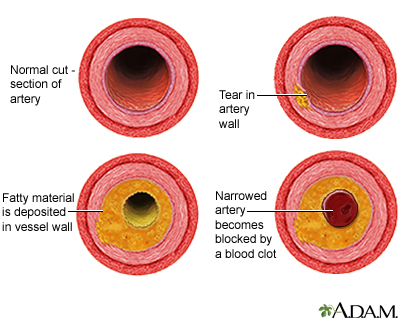
Over time, these plaques can block the arteries and cause heart disease, stroke, and other symptoms or problems throughout the body.
Disorders that are passed down through families often lead to higher cholesterol levels that are harder to control.
Cholesterol – high; Lipid disorders; Hyperlipoproteinemia; Hyperlipidemia; Dyslipidemia; Hypercholesterolemia
📖 What Are Patient Instructions?
What Are Patient Instructions?

- Angina – discharge
- Angioplasty and stent – heart – discharge
- Antiplatelet medicines – P2Y12 inhibitors
- Aspirin and heart disease
- Being active after your heart attack
- Being active when you have heart disease
- Butter, margarine, and cooking oils
- Cardiac catheterization – discharge
- Cholesterol and lifestyle
- Cholesterol – drug treatment
- Cholesterol – what to ask your doctor
- Controlling your high blood pressure
- Diabetes – preventing heart attack and stroke
- Dietary fats explained
- Fast food tips
- Heart attack – discharge
- Heart bypass surgery – discharge
- Heart bypass surgery – minimally invasive – discharge
- Heart disease – risk factors
- Heart failure – fluids and diuretics
- Heart failure – home monitoring
- Heart pacemaker – discharge
- How to read food labels
- Low-salt diet
- Mediterranean diet
- Stroke – discharge
- Type 2 diabetes – what to ask your doctor
-
 Cholesterol producers
 -
 Coronary artery disease
 -
 Cholesterol
 -
 Developmental process of atherosclerosis
 Cholesterol producers
 Coronary artery disease
 Cholesterol
 Developmental process of atherosclerosis
American Diabetes Association Professional Practice Committee. 10. Cardiovascular disease and risk management: standards of care in diabetes-2025.
Diabetes Care . 2025;48(Supplement_1):S207-S238. PMID: 39651970 pubmed.ncbi.nlm.nih.gov/39651970/ .
Arnett DK, Blumenthal RS, Albert MA, et al. 2019 ACC/AHA Guideline on the primary prevention of cardiovascular disease: executive summary: a report of the American College of Cardiology/American Heart Association Task Force on Clinical Practice Guidelines.
Circulation.
2019;140(11):e563-e595. PMID: 30879339 pubmed.ncbi.nlm.nih.gov/30879339/ .
Genest J, Mora S, Libby P. Lipoprotein disorders and cardiovascular disease. In: Libby P, Bonow RO, Mann DL, Tomaselli GF, Bhatt DL, Solomon SD, eds.
Braunwald’s Heart Disease: A Textbook of Cardiovascular Medicine.
12th ed. Philadelphia, PA: Elsevier; 2022:chap 27.
Grundy SM, Stone NJ, Bailey AL, et al. 2018 AHA/ACC/AACVPR/AAPA/ABC/ACPM/ADA/AGS/APhA/ASPC/NLA/PCNA guideline on the management of blood cholesterol: executive summary; a report of the American College of Cardiology/American Heart Association Task Force on Clinical Practice Guidelines.
J Am Coll Cardiol.
2019;73(24):3168-3209. PMID: 30423391 pubmed.ncbi.nlm.nih.gov/30423391/ .
Robinson JG. Disorders of lipid metabolism. In: Goldman L, Cooney KA, eds.
Goldman-Cecil Medicine.
27th ed. Philadelphia, PA: Elsevier; 2024:chap 190.
US Preventive Services Task Force; Mangione CM, Barry MJ, et al. Statin use for the primary prevention of cardiovascular disease in adults: US Preventive Services Task Force Recommendation Statement.
JAMA . 2022;328(8):746-753. PMID: 35997723 pubmed.ncbi.nlm.nih.gov/35997723/ .
US Preventive Services Task Force; Barry MJ, Nicholson WK, et al. Screening for lipid disorders in children and adolescents: US Preventive Services Task Force Recommendation Statement.
JAMA . 2023;330(3):253-260. PMID: 37462699 pubmed.ncbi.nlm.nih.gov/37462699/ .
📖 What Is Test Your Knowledge?
What Is Test Your Knowledge?
Updated by: Michael A. Chen, MD, PhD, Associate Professor of Medicine, Division of Cardiology, Harborview Medical Center, University of Washington Medical School, Seattle, WA. Also reviewed by David C. Dugdale, MD, Medical Director, Brenda Conaway, Editorial Director, and the A.D.A.M. Editorial team.
- Cholesterol
- Cholesterol Levels: What You Need to Know
Frequently Asked Questions
Key Takeaways
High cholesterol levels can lead to
American Diabetes Association Professional Practice Committee.
What Are the Common Causes and Risk Factors?
Total cholesterol — all the cholesterols combined High density lipoprotein (HDL) cholesterol — often called good cholesterol Low density lipoprotein (LDL) cholesterol — often called bad cholesterol For many people, abnormal cholesterol levels are partly due to lifestyle choices . This often includes eating a diet that is high in fat .
What Are Exams and Tests?
How Is It Treated?
Quit smoking . This is the single biggest change you can make to reduce your risk of heart attack and stroke. Eat foods that are naturally low in fat.
What Is Outlook (Prognosis)?
About the Author: This article was researched and written by the SilverWell Hub editorial team. It was reviewed by the SilverWell Hub editorial team.
Sources: This article is adapted from MedlinePlus, a service of the National Library of Medicine.
Disclaimer: This information is for educational purposes only. See our full Medical Disclaimer.
Published: July 19, 2026