

What Are the Common Causes and Risk Factors?
Many factors can affect blood pressure, including:
- The amount of water and salt you have in your body
- The condition of your kidneys, nervous system, or blood vessels
- Your hormone levels
You are more likely to be told your blood pressure is too high as you get older. This is because your blood vessels become stiffer as you age. When that happens, your blood pressure goes up. High blood pressure increases your chance of having a stroke, heart attack, heart failure, kidney disease, or early death.
You have a higher risk for high blood pressure if you:
- Are African American
- Are obese
- Are often stressed or anxious
- Drink alcohol (more than 1 drink per day for women and more than 2 drinks per day for men)
- Eat too much salt
- Have a family history of high blood pressure
-
Have
diabetes - Smoke or use tobacco
Most of the time, no cause of high blood pressure is found. This is called essential hypertension.
High blood pressure that is caused by another medical condition or medicine you are taking is called secondary hypertension. Secondary hypertension may be due to:
- Chronic kidney disease
- Disorders of the adrenal gland (such as pheochromocytoma or Cushing syndrome )
- Hyperparathyroidism
-
Pregnancy or
preeclampsia - Medicines such as birth control pills, diet pills, some cold medicines, migraine medicines, corticosteroids, some antipsychotics, and certain medicines used to treat cancer
- Narrowed artery that supplies blood to the kidney ( renal artery stenosis )
- Obstructive sleep apnea
(OSA)
What Are the Symptoms and Warning Signs?
Most of the time, there are no symptoms. For most people, high blood pressure is found when they visit their provider or have it checked elsewhere.
Because there are no symptoms, people can develop heart disease and kidney problems without knowing they have high blood pressure.
Malignant hypertension is a dangerous form of very high blood pressure. Symptoms may include:
-
Severe
headache - Nausea and vomiting
- Confusion
- Vision changes
- Nosebleeds
📖 What Are Exams and Tests?
What Are Exams and Tests?
Diagnosing and treating high blood pressure early can help prevent heart disease, stroke, eye problems, and chronic kidney disease.
Your provider will measure your blood pressure several times before diagnosing you with high blood pressure. It is normal for your blood pressure to be different based on the time of day.
All adults age 18 or older should have their blood pressure checked periodically. For people age 40 or older, checking blood pressure once per year is recommended. For some people age 18 to 39, checking less often may be fine. More frequent measurements may be needed for those with a history of high blood pressure readings or those with risk factors for high blood pressure. Check with your provider about what is best for you.
Blood pressure readings taken at home may be a better measure of your current blood pressure than those taken at your provider’s office.
- Make sure you get a good quality, well-fitting home blood pressure monitor . It should have a properly sized cuff and a digital readout.
- Practice with your provider to make sure you are taking your blood pressure correctly.
- You should be relaxed and seated for five or more minutes prior to taking a reading.
- Bring your home monitor to your appointments so your provider can make sure it is working correctly.
Your provider will do a physical exam to look for signs of heart disease, damage to your eyes, and other changes in your body.
Tests may also be done to look for:
- High cholesterol level
- Heart disease, using tests such as an echocardiogram or electrocardiogram
- Diabetes and kidney disease, using tests such as a basic metabolic panel blood test, urinalysis , or ultrasound of the kidneys
📖 How Is It Treated?
How Is It Treated?
The goal of treatment is to reduce your blood pressure so that you have a lower risk of health problems caused by high blood pressure. You and your provider should set a blood pressure goal for you.
Whenever thinking about the best treatment for high blood pressure, you and your provider must consider other factors such as:
- Your age
- The medicines you take
- Your risk of side effects from possible medicines
- Other medical conditions you may have, such as a history of heart disease, stroke, kidney problems, or diabetes
If the top blood pressure number is from 120 to 129 mm Hg, and the bottom blood pressure number is less than 80 mm Hg, you have what is called elevated blood pressure.
- Your provider will recommend lifestyle changes to bring your blood pressure down to a normal range.
- Medicines are rarely used at this stage.
If your blood pressure is 130/80 or higher, but lower than 140/90 mm Hg, you have Stage 1 high blood pressure. When thinking about the best treatment, you and your provider must consider:
- If you have no other diseases or risk factors for heart or kidney disease, your provider may recommend lifestyle changes and repeat the measurements after a few months.
- If your blood pressure remains 130/80 or above, but lower than 140/90 mm Hg, your provider may recommend medicines to treat high blood pressure.
- If you have other diseases or risk factors for heart or kidney disease, your provider may be more likely to recommend medicines at the same time as lifestyle changes.
If your blood pressure is 140/90 mm Hg or higher, you have Stage 2 high blood pressure. Your provider will most likely recommend medicines and lifestyle changes together.
Before making a final diagnosis of either elevated blood pressure or high blood pressure, your provider should ask you to have your blood pressure measured at home, at your pharmacy, or somewhere else besides their office or a hospital.
LIFESTYLE CHANGES
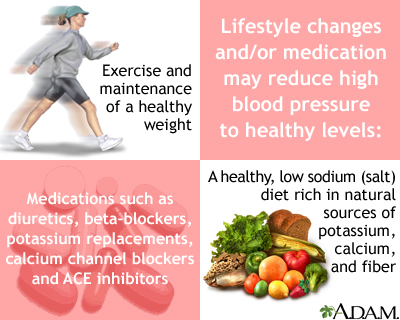
You can do many things to help control your blood pressure, including:
- Eat a heart-healthy diet , including potassium and fiber.
- Drink plenty of water.
- Get at least 150 minutes of moderate to vigorous aerobic exercise per week.
- If you smoke or use tobacco, quit.
- Limit how much alcohol you drink to 1 drink a day for women, and 2 drinks a day for men or less and consider quitting entirely.
- Limit the amount of sodium (salt) you eat. Aim for less than 1,500 mg per day of sodium.
- Reduce stress. Try to avoid things that cause you stress, and try meditation or yoga to de-stress.
- Stay at a healthy body weight.
Your provider can help you find programs for losing weight, stopping smoking, and exercising.
You can also get a referral to a dietitian, who can help you plan a diet that is healthy for you.
How low your blood pressure should be and at what level you need to start treatment is individualized, based on your age and any medical problems you have. Ask your provider what your blood pressure goal is.
MEDICINES FOR HYPERTENSION
Most of the time, your provider will suggest you try lifestyle changes first and check your blood pressure two or more times. Medicines will likely be recommended if your blood pressure readings remain at or above these levels:
- Top number (systolic pressure) of 130 or more
- Bottom number (diastolic pressure) of 80 or more
If you have diabetes, heart problems, or a history of a stroke, medicines may be started at lower blood pressure reading. The most commonly used blood pressure targets for people with these medical problems are below 120 to 130/80 mm Hg.
There are many different medicines to treat high blood pressure .
- Often, a single blood pressure medicine may not be enough to control your blood pressure, and you may need to take two or more medicines.
- It is very important that you take the medicines prescribed to you.
- If you have side effects, tell your provider promptly so they can substitute a different medicine.
📖 What Is Outlook (Prognosis)?
What Is Outlook (Prognosis)?

Most of the time, high blood pressure can be controlled with medicine and lifestyle changes.
When blood pressure is not well-controlled, you are at risk for:
- Bleeding from the aorta, the large blood vessel that supplies blood to the abdomen, pelvis, and legs
- Chronic kidney disease
-
Heart attack and
heart failure - Poor blood supply to the legs
- Problems with your vision
- Stroke
📖 When to Contact a Medical Professional?
When to Contact a Medical Professional?
If you have high blood pressure, you should have regular follow-up visits with your provider.
Even if you have not been diagnosed with high blood pressure, it is important to have your blood pressure checked during your regular check-up, especially if someone in your family has or had high blood pressure.
Contact your provider right away if home monitoring shows that your blood pressure is still high.
📖 How Is It Prevented?
How Is It Prevented?
Many people can prevent or delay high blood pressure from occurring by following lifestyle changes designed to bring blood pressure down.
Hypertension; HBP; High blood pressure
📖 What Are Patient Instructions?
What Are Patient Instructions?

- ACE inhibitors
- Angioplasty and stent – heart – discharge
- Antiplatelet medicines – P2Y12 inhibitors
- Aspirin and heart disease
- Butter, margarine, and cooking oils
- Cholesterol and lifestyle
- Controlling your high blood pressure
- Diabetes eye care
- Diabetes – preventing heart attack and stroke
- Diabetes – taking care of your feet
- Diabetes tests and checkups
- Dietary fats explained
- Fast food tips
- Heart attack – discharge
- Heart disease – risk factors
- Heart failure – discharge
- Heart failure – fluids and diuretics
- Heart failure – home monitoring
- Heart failure – what to ask your doctor
- High blood pressure – what to ask your doctor
- How to read food labels
- Implantable cardioverter defibrillator – discharge
- Kidney removal – discharge
- Low-salt diet
- Mediterranean diet
- Type 2 diabetes – what to ask your doctor
-
 Monitoring blood pressure
 -
 Untreated hypertension
 -
 Lifestyle changes
 -
 DASH diet
 -
 Blood pressure
 Monitoring blood pressure
 Untreated hypertension
 Lifestyle changes
 DASH diet
 Blood pressure
American Diabetes Association Professional Practice Committee. 10. Cardiovascular disease and risk management: standards of care in diabetes-2025.
Diabetes Care . 2025;48(Supplement_1):S207-S238. PMID: 39651970 pubmed.ncbi.nlm.nih.gov/39651970/ .
Arnett DK, Blumenthal RS, Albert MA, et al. 2019 ACC/AHA guideline on the primary prevention of cardiovascular disease: a report of the American College of Cardiology/American Heart Association Task Force on Clinical Practice Guidelines.
Circulation . 2019;140(11);e596-e646. PMID: 30879355 pubmed.ncbi.nlm.nih.gov/30879355/ .
Bakris GL, Sorrentino MJ. Systemic hypertension: mechanisms, diagnosis and treatment. In: Libby P, Bonow RO, Mann DL, Tomaselli GF, Bhatt DL, Solomon SD, eds.
Braunwald’s Heart Disease: A Textbook of Cardiovascular Medicine . 12th ed. Philadelphia, PA: Elsevier; 2022:chap 26.
Flack JM. Arterial hypertension. In: Goldman L, Cooney KA, eds.
Goldman-Cecil Medicine . 27th ed. Philadelphia, PA: Elsevier; 2024:chap 64.
Whelton PK, Carey RM, Aronow WS, et al. 2017 ACC/AHA/AAPA/ABC/ACPM/AGS/APhA/ASH/ASPC/NMA/PCNA guideline for the prevention, detection, evaluation, and management of high blood pressure in adults: a report of the American College of Cardiology/American Heart Association Task Force on Clinical Practice Guidelines.
Hypertension . 2018;71(6):1269-1324. PMID: 29133354 pubmed.ncbi.nlm.nih.gov/29133354/ .
📖 What Is Test Your Knowledge?
What Is Test Your Knowledge?
Updated by: Jacob Berman, MD, MPH, Clinical Assistant Professor of Medicine, Division of General Internal Medicine, University of Washington School of Medicine, Seattle, WA. Also reviewed by David C. Dugdale, MD, Medical Director, Brenda Conaway, Editorial Director, and the A.D.A.M. Editorial team.
- High Blood Pressure
About the Author: This article was researched and written by the SilverWell Hub editorial team. It was reviewed by the SilverWell Hub editorial team.
Sources: This article is adapted from MedlinePlus, a service of the National Library of Medicine.
Disclaimer: This information is for educational purposes only. See our full Medical Disclaimer.
Published: July 15, 2026
Frequently Asked Questions
Key Takeaways
What Are the Common Causes and Risk Factors?
The amount of water and salt you have in your body The condition of your kidneys, nervous system, or blood vessels Your hormone levels You are more likely to be told your blood pressure is too high as you get older. This is because your blood vessels become stiffer as you age.
What Are the Symptoms and Warning Signs?
What Are Exams and Tests?
How Is It Treated?
Your age The medicines you take Your risk of side effects from possible medicines Other medical conditions you may have, such as a history of heart disease, stroke, kidney problems, or diabetes If the top blood pressure number is from 120 to 129 mm Hg, and the bottom blood pressure number is less than 80 mm Hg, you have what is called elevated blood pressure.