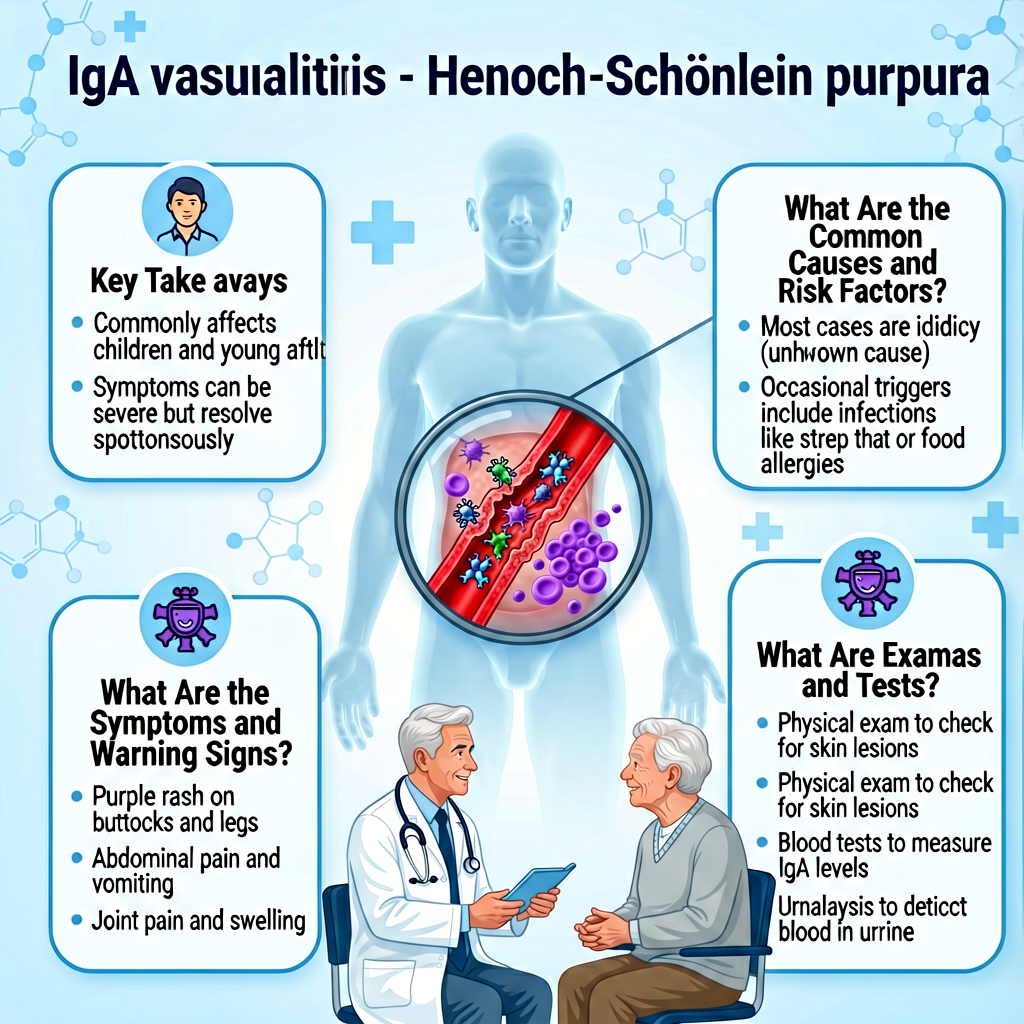

IgA vasculitis is a disease that involves purple spots on the skin, joint pain, gastrointestinal problems, and glomerulonephritis (a type of kidney disorder). It is also known as Henoch-Schönlein purpura (HSP).
What Are the Common Causes and Risk Factors?
IgA vasculitis is caused by an abnormal response of the immune system. The result is inflammation in the microscopic blood vessels in the skin. Blood vessels in the joints, kidneys, or the intestines may also be affected. It is unclear why this occurs.
The syndrome is mostly seen in children between ages 3 and 15 years, but it may be seen in adults. It is more common in boys than in girls. Many people who develop this disease had an upper respiratory infection in the weeks before.
What Are the Symptoms and Warning Signs?
Symptoms and features of IgA vasculitis may include:
- Purple spots on the skin ( purpura ). This occurs in nearly all children with the condition. This most often occurs over the buttocks, lower legs, and elbows.
- Abdominal pain
. - Joint pain
. - Abnormal urine (may have no symptoms).
- Diarrhea, sometimes bloody
. - Hives or angioedema .
- Nausea and vomiting.
- Swelling and pain in the scrotum of boys.
- Headache.
📖 What Are Exams and Tests?
What Are Exams and Tests?
The health care provider will look at your body and look at your skin. The physical exam will show skin sores (purpura, lesions) and joint tenderness.
Tests may include:
- Urinalysis
should be done in all cases. - Complete blood count
. The platelet should be normal. - Coagulation tests: these should be normal.
- Skin biopsy
, especially in adults. - Blood tests to look for other causes of blood vessel inflammation, such as systemic lupus erythematosus , ANCA-associated vasculitis or hepatitis .
- In adults, a kidney biopsy should be done.
- Imaging tests of the abdomen if pain is present.
📖 How Is It Treated?
How Is It Treated?
There is no specific treatment. Most cases go away on their own. Joint pain may improve with NSAIDs such as naproxen. If symptoms do not go away, you may be prescribed a corticosteroid medicine such as prednisone.
📖 What Is Outlook (Prognosis)?
What Is Outlook (Prognosis)?
The disease most often gets better on its own. Two thirds of children with IgA vasculitis have only one episode. One third of children have more episodes. People should have close medical follow-up for 6 months after episodes to look for signs of kidney disease. Adults have a greater risk of developing chronic kidney disease.
📖 What Are Possible Complications?
What Are Possible Complications?
Complications may include:
- Bleeding inside the body
- Blocking of the intestine (in children)
- Kidney problems (in rare cases)
📖 When to Contact a Medical Professional?
When to Contact a Medical Professional?
Contact your provider if:
- You develop symptoms of IgA vasculitis, and they last for more than a few days.
- You have colored urine or low urine output after an episode.
Immunoglobulin A vasculitis; Leukocytoclastic vasculitis; Henoch-Schönlein purpura; HSP; IgA vasculitis – Henoch-Schönlein purpura
-
 Henoch-Schonlein purpura on the lower legs
 -
 Henoch-Schonlein purpura
 -
 Henoch-Schonlein purpura
 -
 Henoch-Schonlein purpura
 -
 Henoch-Schonlein purpura on an infant’s foot
 -
 Henoch-Schonlein purpura on an infant’s legs
 -
 Henoch-Schonlein purpura on an infant’s legs
 -
 Henoch-Schonlein purpura on the legs
 Henoch-Schonlein purpura on the lower legs
 Henoch-Schonlein purpura
 Henoch-Schonlein purpura
 Henoch-Schonlein purpura
 Henoch-Schonlein purpura on an infant’s foot
 Henoch-Schonlein purpura on an infant’s legs
 Henoch-Schonlein purpura on an infant’s legs
 Henoch-Schonlein purpura on the legs
Dinulos JGH. Hypersensitivity syndromes and vasculitis. In: Dinulos JGH, ed.
Habif’s Clinical Dermatology . 7th ed. Philadelphia, PA: Elsevier; 2021:chap 18.
Stone JH. The systemic vasculitides. In: Goldman L, Cooney KA, eds.
Goldman-Cecil Medicine . 27th ed. Philadelphia, PA: Elsevier; 2024:chap 249.
Stone JH. Immune complex–mediated small vessel vasculitis. In: Firestein GS, McInnes IB, Koretzky GA, Mikuls TR, Neogi T, O’Dell JR, eds.
Firestein & Kelley’s Textbook of Rheumatology . 12th ed. Philadelphia, PA: Elsevier; 2025:chap 92.
Sunderkötter CH, Zelger B, Chen KR, et al. Nomenclature of cutaneous vasculitis: Dermatologic addendum to the 2012 revised International Chapel Hill Consensus Conference Nomenclature of Vasculitides.
Arthritis Rheumatol . 2018;70(2):171-184. PMID: 29136340 pubmed.ncbi.nlm.nih.gov/29136340/ .
Updated by: Diane M. Horowitz, MD, Rheumatology and Internal Medicine, Northwell Health, Great Neck, NY. Review provided by VeriMed Healthcare Network. Also reviewed by David C. Dugdale, MD, Medical Director, Brenda Conaway, Editorial Director, and the A.D.A.M. Editorial team.
- Skin Conditions
- Vasculitis
Frequently Asked Questions
Key Takeaways
The health care provider will look at your body and look at your skin. There is no specific treatment.
What Are the Common Causes and Risk Factors?
What Are the Symptoms and Warning Signs?
Purple spots on the skin ( purpura ). This occurs in nearly all children with the condition. This most often occurs over the buttocks, lower legs, and elbows.
What Are Exams and Tests?
Urinalysis should be done in all cases.
How Is It Treated?
About the Author: This article was researched and written by the SilverWell Hub editorial team. It was reviewed by the SilverWell Hub editorial team.
Sources: This article is adapted from MedlinePlus, a service of the National Library of Medicine.
Disclaimer: This information is for educational purposes only. See our full Medical Disclaimer.
Published: July 22, 2026