
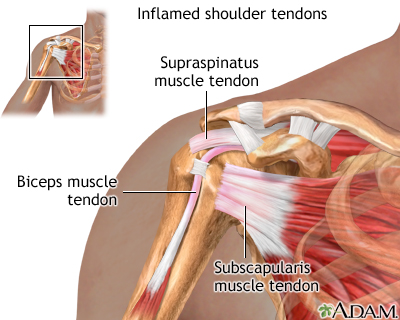
The rotator cuff is a group of muscles and tendons that attach to the bones of the shoulder joint, allowing the shoulder to move and keep it stable.
- Rotator cuff tendinitis refers to irritation of these tendons and inflammation of the bursa (a normally smooth layer) lining these tendons.
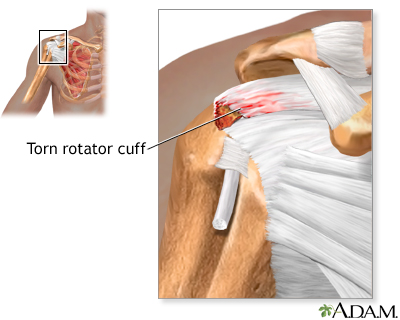
- A rotator cuff tear occurs when one of the tendons is torn from the bone from overuse or injury.
What Are the Common Causes and Risk Factors?
The shoulder joint is a ball and socket type joint. The top part of the arm bone (humerus) forms a joint with the shoulder blade (scapula). The rotator cuff holds the head of the humerus into the scapula. It also controls movement of the shoulder joint.
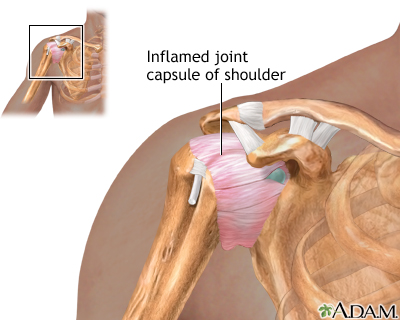
TENDINITIS
The tendons of the rotator cuff pass underneath a bony area on their way to attaching to the top part of the arm bone. When these tendons become inflamed, they can become more inflamed over this area during shoulder movements.
Rotator cuff tendinitis is also called impingement syndrome. Causes of this condition include:
- Keeping the arm in the same position for long periods, such as doing computer work or hairstyling
- Sleeping on the same arm each night
- Playing sports requiring the arm to be moved overhead repeatedly such as in tennis, baseball (particularly pitching), swimming, and lifting weights overhead
- Working with the arm overhead for many hours or days, such as in painting and carpentry
- Poor posture over many years
- Aging
- Rotator cuff tears
TEARS
Rotator cuff tears may occur in two ways:
- A sudden acute tear may happen when you fall on your arm while it is stretched out. Or, it can occur after a sudden, jerking motion when you try to lift something heavy.
- A chronic tear of the rotator cuff tendon occurs slowly over time. It is more likely when you have chronic tendinitis or impingement syndrome. At some point, the tendon wears down and tears.
There are two types of rotator cuff tears:
- A partial tear occurs when a tear does not completely sever the attachments to the bone.
- A complete, full thickness tear means that the tear goes all the way through the tendon. It may be as small as a pinpoint, or the tear may involve the entire tendon. With complete tears, the tendon has come off (detached) from where it was attached to the bone. It can also be retracted and be pulled away from the bone. Retracted tears do not heal on their own.
What Are the Symptoms and Warning Signs?
TENDINITIS
Early on, pain is mild and occurs with overhead activities and lifting your arm to the side. Activities include brushing your hair, reaching for objects on shelves, or playing an overhead sport.
Pain is more likely in the front of the shoulder and may travel to the side of the arm. The pain always stops above the elbow. If the pain goes down the arm to the elbow and hand, this may indicate a pinched nerve in the neck.
There may also be pain when you lower the shoulder from a raised position.
Over time, there may be pain at rest or at night, such as when lying on the affected shoulder. You may have weakness and loss of motion when raising the arm above your head. Your shoulder can feel stiff with lifting or movement. It may become more difficult to place the arm behind your back.
ROTATOR CUFF TEARS
The pain with a sudden tear after a fall or injury is usually intense. Right after the injury, you will likely have weakness of the shoulder and arm. It may be hard to move your shoulder or raise your arm above the shoulder. You may also feel snapping when trying to move the arm.
With a chronic tear, you often do not notice when it began. This is because symptoms of pain, weakness, and stiffness or loss of motion worsen slowly over time.
Rotator cuff tendon tears often cause pain at night. The pain may even wake you. During the day, the pain is more tolerable, and usually only hurts with certain movements, such as overhead or reaching toward the back.
Over time, the symptoms become much worse and are not relieved by medicines, rest, or exercise.
📖 What Are Exams and Tests?
What Are Exams and Tests?
A physical exam may reveal tenderness over the shoulder. Pain may occur when the shoulder is raised overhead. There is often weakness of the shoulder when it is placed in certain positions.
X-rays of the shoulder may show a bone spur or change in the position of the shoulder. It can also check for other causes of shoulder pain, such as arthritis.
Your health care provider may order other tests:
- An ultrasound test uses sound waves to create an image of the shoulder joint. It can show a tear in the rotator cuff.
- MRI of the shoulder
may show swelling or a tear in the rotator cuff. - With a joint x-ray ( arthrogram ), the provider injects contrast material (dye) into the shoulder joint. Then an x-ray, CT scan , or MRI scan is used to take multiple pictures of it. Contrast is usually used when your provider suspects a small rotator cuff tear.
📖 How Is It Treated?
How Is It Treated?
Follow your provider’s instructions on how to take care of your rotator cuff problem at home . Doing so can help relieve your symptoms so that you can return to sports or other activities.
TENDINITIS
Your provider will likely advise you to rest your shoulder and avoid activities that cause pain. Other measures include:
- Ice packs applied 20 minutes at a time, 3 to 4 times a day to the shoulder (protect the skin by wrapping the ice pack in a clean towel before applying)
- Taking medicines, such as ibuprofen or naproxen, to help reduce swelling and pain
- Avoiding or reducing activities that cause or worsen your symptoms
-
Physical therapy to
stretch and strengthen the shoulder muscles - Medicine (corticosteroid) injected into the shoulder to reduce pain and swelling
- Surgery ( arthroscopy ) to remove inflamed tissue and part of the bone over the rotator cuff to decrease inflammation on the tendons
TEARS
Rest and physical therapy may help with a partial tear if you do not normally place a lot of demand on your shoulder.
Surgery to repair the tendon may be needed if the rotator cuff has a complete tear. Surgery may also be needed if the symptoms do not get better with other treatment. Most of the time, arthroscopic surgery can be used. Large tears may need open surgery (surgery with a larger incision) to repair the torn tendon or use other tissue to help the repair to heal.
📖 What Is Outlook (Prognosis)?
What Is Outlook (Prognosis)?
With rotator cuff tendinitis, rest, exercise and other self-care measures often improve or even relieve symptoms. This may take weeks or months. Some people may need to change or reduce the amount of time they play certain sports to remain pain-free.
With rotator cuff tears, treatment often relieves symptoms. But the outcome depends on the size of the tear and how long the tear has been present, the person’s age, and how active the person was before the injury.
📖 When to Contact a Medical Professional?
When to Contact a Medical Professional?
Contact your provider if you have ongoing shoulder pain. Also contact your provider if symptoms do not improve with treatment.
📖 How Is It Prevented?
How Is It Prevented?
Avoid repetitive overhead movements. Exercises to strengthen shoulder and arm muscles can also help prevent rotator cuff problems. Practice good posture to keep your rotator cuff tendons and muscles in their right positions.
Swimmer’s shoulder; Pitcher’s shoulder; Shoulder impingement syndrome; Tennis shoulder; Tendinitis – rotator cuff; Rotator cuff tendinitis; Shoulder overuse syndrome
📖 What Are Patient Instructions?
What Are Patient Instructions?
- Rotator cuff exercises
- Rotator cuff – self-care
- Shoulder surgery – discharge
- Using your shoulder after replacement surgery
- Using your shoulder after surgery
-
 Shoulder joint inflammation
 -
 Inflamed shoulder tendons
 -
 Normal rotator cuff
 -
 Torn rotator cuff
 Shoulder joint inflammation
 Inflamed shoulder tendons
 Normal rotator cuff
 Torn rotator cuff
Mosich GM, Yamaguchi KT, Petrigliano FA. Rotator cuff and impingement lesions. In: Miller MD, Thompson SR, eds.
DeLee, Drez, & Miller’s Orthopaedic Sports Medicine: Principles and Practice . 5th ed. Philadelphia, PA: Elsevier; 2020:chap 47.
Ricchetti ET, Entezari V, Derwin KA. Structure and function of the rotator cuff. In: Matsen FA, Cordasco FA, Sperling JW, et al, eds.
Rockwood and Matsen’s The Shoulder . 6th ed. Philadelphia, PA: Elsevier; 2022:chap 50.
Updated by: C. Benjamin Ma, MD, Professor, Chief, Sports Medicine and Shoulder Service, UCSF Department of Orthopaedic Surgery, San Francisco, CA. Also reviewed by David C. Dugdale, MD, Medical Director, Brenda Conaway, Editorial Director, and the A.D.A.M. Editorial team.
- Rotator Cuff Injuries
- Sports Injuries
- Tendinitis
Frequently Asked Questions
Key Takeaways
With rotator cuff tendinitis, rest, exercise and other self-care measures often improve or even relieve symptoms.
What Are the Common Causes and Risk Factors?
What Are the Symptoms and Warning Signs?
What Are Exams and Tests?
How Is It Treated?
About the Author: This article was researched and written by the SilverWell Hub editorial team. It was reviewed by the SilverWell Hub editorial team.
Sources: This article is adapted from MedlinePlus, a service of the National Library of Medicine.
Disclaimer: This information is for educational purposes only. See our full Medical Disclaimer.
Published: July 21, 2026