

A urinary tract infection, or UTI, is an infection of the urinary tract. The infection can occur at different points in the urinary tract, including the:
- Bladder — An infection in the bladder is also called cystitis or a bladder infection.
- Kidneys — An infection of one or both kidneys is called pyelonephritis or a kidney infection.
- Ureters — The tubes that take urine from each kidney to the bladder are rarely the only site of infection.
- Urethra — An infection of the tube that empties urine from the bladder to the outside is called urethritis .
What Are the Common Causes and Risk Factors?
Most UTIs are caused by bacteria that enter the urethra and then the bladder. The infection most commonly develops in the bladder, but can spread to the kidneys. Most of the time, your body can get rid of these bacteria. However, certain conditions increase the risk for having UTIs.
Women tend to get them more often because their urethra is shorter and closer to the anus than in men. Because of this, women are more likely to get an infection after sexual activity or when using a diaphragm for birth control. Menopause also increases the risk for a UTI.
The following also increase your chances of developing a UTI:
- Diabetes
- Advanced age
- Conditions that affect personal care habits (such as Alzheimer disease and delirium )
- Problems emptying the bladder completely
- Having a urinary catheter
- Bowel incontinence
- Enlarged prostate , narrowed urethra , or anything that blocks the flow of urine
- Kidney stones
- Staying still (immobile) for a long period of time (for example, while you are recovering from a hip fracture)
- Pregnancy
- Surgery or other procedure involving the urinary tract
What Are the Symptoms and Warning Signs?
The symptoms of a bladder infection include:
- Cloudy
or bloody urine, which may have a foul or strong odor - Low grade fever in some people
-
Pain or burning with
urination - Pressure or cramping in the lower abdomen or back
- Strong need to urinate often, even right after the bladder has been emptied
If the infection spreads to your kidneys, symptoms may include:
- Chills
and shaking or night sweats - Fatigue
and a general ill feeling - Fever above 101°F (38.3°C)
- Pain in the side, back, or groin
- Flushed, warm, or reddened skin
- Mental changes or confusion (in older people, these symptoms often are the only signs of a UTI)
- Nausea
and vomiting - Severe abdominal pain (sometimes)
📖 What Are Exams and Tests?
What Are Exams and Tests?
In many cases, you will need to provide a urine sample for the following tests:
- Urinalysis
— This test is done to look for white blood cells, red blood cells, bacteria, and to test chemicals such as nitrites in the urine. This test can diagnose an infection most of the time. - Clean-catch urine culture
— This test may be done to identify the bacteria and determine the best antibiotic for treatment.
Blood tests such as complete blood count ( CBC ) and a blood culture may be done as well.
You may also need the following tests to help check for other problems in your urinary system:
- CT scan of the abdomen
- Intravenous pyelogram
(IVP) - Kidney ultrasound
- Voiding cystourethrogram
📖 How Is It Treated?
How Is It Treated?
Your health care provider must first decide if the infection is just in the bladder, or if it has spread to the kidneys and how severe it is.
MILD BLADDER AND KIDNEY INFECTIONS
- Most of the time, you will need to take an antibiotic to prevent the infection from spreading to the kidneys.
- For a simple bladder infection, you will take antibiotics for 1 to 5 days (women) or 7 to 14 days (men). The length of treatment depends on the antibiotic used.
- If you are pregnant or have diabetes, or have a mild kidney infection, you will most often take antibiotics for 7 to 14 days.
- Finish all of the antibiotics, even if you feel better. If you do not finish the whole dose of medicine, the infection may return and be harder to treat later.
- Always drink plenty of water when you have a bladder or kidney infection.
- Tell your provider if you might be pregnant before taking these medicines.
RECURRENT BLADDER INFECTIONS
Some women have repeated bladder infections. Your provider may suggest that you:
- Take a single dose of an antibiotic after sexual contact to prevent an infection.
- Have a 3 to 5 day course of antibiotics at home to use if you develop an infection.
- Take a single, daily dose of an antibiotic to prevent infections.
MORE SEVERE KIDNEY INFECTIONS
You may need to go into the hospital if you are very sick and cannot take medicines by mouth or drink enough fluids. You may also be admitted to the hospital if you:
- Are an older adult
- Have kidney stones or changes in the anatomy of your urinary tract
- Have recently had urinary tract surgery
- Have cancer, diabetes, multiple sclerosis , spinal cord injury, or other medical problems
- Are pregnant and have a fever or are otherwise ill
At the hospital, you will receive fluids and antibiotics through a vein.
Some people have UTIs that do not go away with treatment or keep coming back. These are called chronic UTIs. If you have a chronic UTI, you may need stronger antibiotics or to take medicine for a longer time.
You may need surgery if the infection is caused by a problem with the structure of the urinary tract.
📖 What Is Outlook (Prognosis)?
What Is Outlook (Prognosis)?

Most UTIs can be cured. Bladder infection symptoms most often go away within 24 to 48 hours after treatment begins. If you have a kidney infection, it may take 1 week or longer for symptoms to go away.
📖 What Are Possible Complications?
What Are Possible Complications?
Complications may include:
- Life-threatening overreaction in the body to the infection ( sepsis ) — The risk is greater among the young, very old adults, and people whose bodies cannot fight infections (for example, due to HIV or cancer chemotherapy).
- Kidney damage or scarring.
- Kidney infection.
📖 When to Contact a Medical Professional?
When to Contact a Medical Professional?
Contact your provider if you have symptoms of a UTI. Contact your provider right away if you have signs of a possible kidney infection, such as:
- Back or side pain
- Chills
- Fever
- Vomiting
Also contact your provider if UTI symptoms come back shortly after you have been treated with antibiotics.
📖 How Is It Prevented?
How Is It Prevented?

Diet and lifestyle changes may help prevent some UTIs. After menopause, a woman may use estrogen cream around the vagina to reduce infections.
Bladder infection – adults; UTI – adults; Cystitis – bacterial – adults; Pyelonephritis – adults; Kidney infection – adults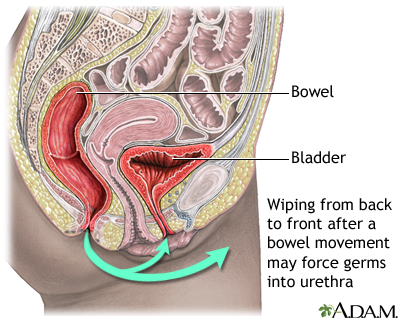
-
 Bladder catheterization – female
 -
 Bladder catheterization – male
 -
 Female urinary tract
 -
 Male urinary tract
 -
 Prevention of cystitis
 Bladder catheterization – female
 Bladder catheterization – male
 Female urinary tract
 Male urinary tract
 Prevention of cystitis
Cooper KL, Badalato GM, Rutman MP. Infections of the urinary tract. In: Partin AW, Dmochowski RR, Kavoussi LR, Peters CA, eds.
Campbell-Walsh-Wein Urology . 12th ed. Philadelphia, PA: Elsevier; 2021:chap 55.
Drekonja D. Approach to the patient with urinary tract infection. In: Goldman L, Cooney KA, eds.
Goldman-Cecil Medicine . 27th ed. Philadelphia, PA: Elsevier; 2024:chap 263.
Sobel JD, Brown P. Urinary tract infections. In: Bennett JE, Dolin R, Blaser MJ, eds.
Mandell, Douglas, and Bennett’s Principles and Practice of Infectious Diseases . 9th ed. Philadelphia, PA: Elsevier; 2020:chap 72.
📖 What Is Test Your Knowledge?
What Is Test Your Knowledge?
Updated by: Linda J. Vorvick, MD, Clinical Professor, Department of Family Medicine, UW Medicine, School of Medicine, University of Washington, Seattle, WA. Also reviewed by David C. Dugdale, MD, Medical Director, Brenda Conaway, Editorial Director, and the A.D.A.M. Editorial team. Editorial update 10/03/25.
- Urinary Tract Infections
Frequently Asked Questions
Key Takeaways
In many cases, you will need to provide a urine sample for the following tests:
Your health care provider must first decide if the infection is just in the bladder, or if it has spread to the kidneys and how severe it is. Most UTIs can be cured.
What Are the Common Causes and Risk Factors?
What Are the Symptoms and Warning Signs?
Cloudy or bloody urine, which may have a foul or strong odor Low grade fever in some people Pain or burning with urination Pressure or cramping in the lower abdomen or back Strong need to urinate often, even right after the bladder has been emptied If the infection spreads to your kidneys, symptoms may include:
Chills and shaking or night sweats Fatigue and a general ill feeling Fever above 101°F (38.3°C) Pain in the side, back, or groin Flushed, warm, or reddened skin Mental changes or confusion (in older people, these symptoms often are the only signs of a UTI) Nausea and vomiting Severe abdominal pain (sometimes) 📖 What Are Exams and Tests?
What Are Exams and Tests?
Urinalysis — This test is done to look for white blood cells, red blood cells, bacteria, and to test chemicals such as nitrites in the urine. This test can diagnose an infection most of the time. Clean-catch urine culture — This test may be done to identify the bacteria and determine the best antibiotic for treatment.
How Is It Treated?
About the Author: This article was researched and written by the SilverWell Hub editorial team. It was reviewed by the SilverWell Hub editorial team.
Sources: This article is adapted from MedlinePlus, a service of the National Library of Medicine.
Disclaimer: This information is for educational purposes only. See our full Medical Disclaimer.
Published: July 19, 2026